Yoga Anatomy
Supine Poses
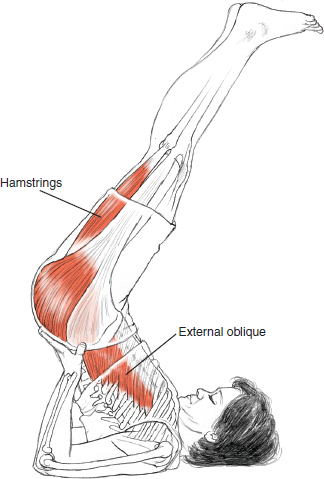
Joint Actions
The cervical and upper thoracic spine flex, while the lower thoracic and lumbar spine extend. The hips flex, adduct, and internally rotate, with knee extension and ankle neutral extension. The scapulae adduct, downwardly rotate, and elevate. The glenohumeral joint externally rotates, extends, and adducts. The elbows flex, and the forearms supinate, with wrist extension (dorsiflexion).
Working
In the spine, the psoas minor, obliques, rectus abdominis, and transversus work eccentrically to resist gravity, while the muscles of the anterior rib cage resist the weight of the lower body.
In the legs, the pectineus adducts, flexes, and internally rotates the legs, while the adductor magnus helps with adduction and internal rotation. The tensor fascia latae assists with internal rotation and flexion, and the vastii extend the knees.
In the shoulders, the rhomboids adduct the scapulae, while the levator scapulae elevates the scapulae, pressing them into the floor and medially rotating the bottom tips. The trapezius helps with scapular adduction, elevation, and medial rotation of the scapulae tips. The pectoralis minor downwardly rotates the scapulae.
In the arms, the infraspinatus and teres minor externally rotate the humerus, while the subscapularis and coracobrachialis eccentrically protect the front of the joint. The long head of the triceps and teres major extend the shoulder and adduct the arm. The posterior deltoid extends and externally rotates the arm, while the biceps brachii and brachialis flex the elbow and supinate the forearm. The flexor carpi radialis, ulnaris, and flexor digitorum superficialis and profundus eccentrically support the weight of the hips.
Lengthening
The abdominal muscles and the muscles of the anterior rib cage lengthen as they work eccentrically.
In the legs, the hamstrings, gastrocnemius, and soleus may feel mild lengthening.
In the shoulders, the serratus anterior, coracobrachialis, pectoralis major, and possibly pectoralis minor (depending on the upper rib cage’s angle) lengthen.
In the arms, the forearm and hand flexors work eccentrically, lengthening while supporting the weight of the pelvis and legs.
Joint Actions
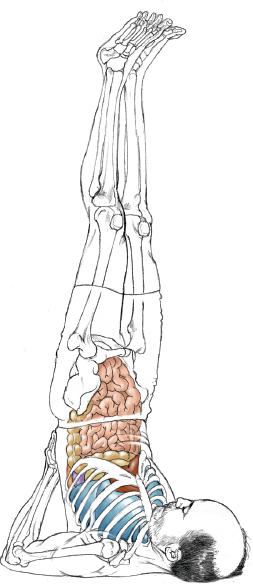
The spine undergoes cervical and thoracic flexion, with lumbar flexion moving toward neutral extension. The sacroiliac joint nutates, and the hips are in neutral extension, adduction, and neutral rotation. The knees extend, and the ankles remain in neutral extension. The scapulae adduct, downwardly rotate, and elevate. The glenohumeral joint externally rotates, extends, and adducts, while the elbows flex and the forearms supinate. The wrists extend, moving toward flexion as the hands press into the back.
Working
In the spine, the intrinsic muscles (intertransversarii, interspinalis, rotatores, multifidi, spinalis, semispinalis, splenius capitis and cervicis, longissimus, and iliocostalis) keep the legs from falling toward the face. The psoas minor, obliques, rectus abdominis, and transversus stabilize to prevent falling backward. In the neck, the rectus capitis posterior major and minor, and obliquus capitis superior and inferior work eccentrically.
In the legs, the adductor magnus and hamstrings stabilize the legs, keeping them extended and together, while the vastii extend the knees. The medial fibers of the gluteus maximus help extend the hips without external rotation.
In the shoulders, the rhomboids adduct the scapulae, and the levator scapulae elevate them, pressing the upper edges into the floor, while medially rotating the scapulae tips. The trapezius also adducts, elevates, and medially rotates the scapulae. The pectoralis minor helps downwardly rotate the scapulae.
In the arms, the infraspinatus and teres minor externally rotate the humerus, while the subscapularis and coracobrachialis work eccentrically to prevent protraction of the shoulder joint. The long head of the triceps and teres major extend the shoulder and adduct the arm, while the posterior deltoid externally rotates and extends the arm. The biceps brachii and brachialis flex the elbow and supinate the forearm. The flexor carpi radialis, ulnaris, and flexor digitorum superficialis and profundus help press the hands into the back.
Lengthening
The muscles of the thoracic spine lengthen as they support the weight of the lower thorax and legs.
In the shoulders, the serratus anterior, coracobrachialis, and pectoralis major lengthen.
Joint Actions
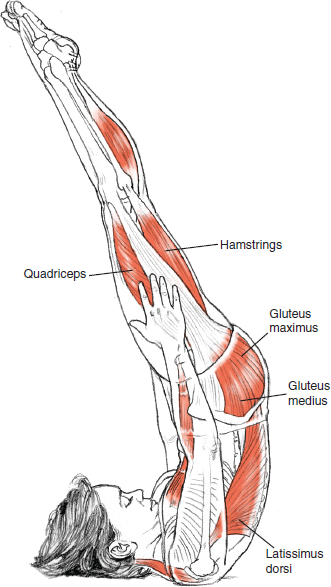
The spine remains in the same position as in Salamba Sarvangasana, with cervical and thoracic flexion and lumbar extension. The legs are also positioned similarly to Salamba Sarvangasana. The arms perform scapular adduction, upward rotation, and elevation. The glenohumeral joint externally rotates with neutral flexion and adduction. The elbows extend, and the forearms pronate to neutral. The wrists and fingers extend to neutral.
Working
The spinal muscles, including the intrinsic spinal muscles and spinal flexors, engage to maintain the position without the support of the arms. The upper fibers of the psoas major and abdominal muscles strongly engage to prevent the torso from collapsing. In the neck, the rectus capitis posterior major and minor, obliquus capitis superior and inferior, along with the deep anterior neck muscles (longus colli, longus capitis, and verticalis), maintain cervical and upper thoracic flexion.
In the legs, the muscles work in the same way as in Salamba Sarvangasana to maintain the alignment and resistance to gravity.
In the shoulders, the rhomboids adduct the scapulae, the serratus anterior upwardly rotates the scapulae, and the levator scapulae elevates the scapulae, pressing them into the floor. The trapezius adducts and elevates the scapulae.
In the arms, the infraspinatus and teres minor externally rotate the humerus, while the biceps brachii and anterior deltoids flex the arms (against gravity). The triceps extend the elbows.
Lengthening
The muscles of the cervical and thoracic spine lengthen as they work to hold the position.
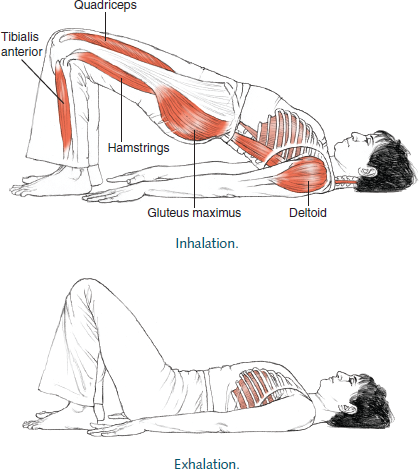
Joint Actions
The spine experiences cervical and upper thoracic flexion, while the lower thoracic and lumbar spine extend. The sacrum moves into counternutation, and the hips extend, adduct, and internally rotate. The knees flex, and the ankles dorsiflex. The scapulae adduct, downwardly rotate, and elevate. The glenohumeral joint externally rotates, extends, and adducts. The elbows flex, and the forearms supinate, while the wrists extend (dorsiflexion).
Working
The spinal extensors, particularly in the mid- and lower thoracic region, engage to lift the torso. The psoas minor and abdominal muscles work eccentrically to prevent excessive lumbar extension.
In the legs, the hamstrings assist in both hip extension and knee flexion, with the medial hamstrings aiding in hip adduction. The adductor magnus extends, internally rotates, and adducts the hips, while the medial fibers of the gluteus maximus support hip extension. The tibialis anterior helps dorsiflex the ankles and pull the knees forward, and the vastii extend the knees.
In the shoulders, the rhomboids adduct the scapulae, the levator scapulae elevates and medially rotates the scapulae, and the trapezius contributes to scapular adduction, elevation, and medial rotation. The pectoralis minor assists in downwardly rotating the scapulae.
In the arms, the infraspinatus and teres minor externally rotate the humerus, while the subscapularis and coracobrachialis work eccentrically to prevent protraction. The long head of the triceps and teres major extend the shoulder and adduct the arms, with the posterior deltoid assisting in extension and external rotation. The biceps brachii and brachialis flex the elbows and supinate the forearms. The flexor carpi radialis, ulnaris, and flexor digitorum muscles work eccentrically to support the weight of the pelvis and legs.
Lengthening
In the spine, the psoas minor, rectus abdominis, obliques, and anterior rib cage muscles lengthen.
In the legs, the rectus femoris, psoas major, and iliacus stretch due to hip extension.
In the shoulders, the serratus anterior, coracobrachialis, pectoralis major, and pectoralis minor lengthen.
In the arms, the forearm and hand flexors lengthen eccentrically while supporting the body’s weight.
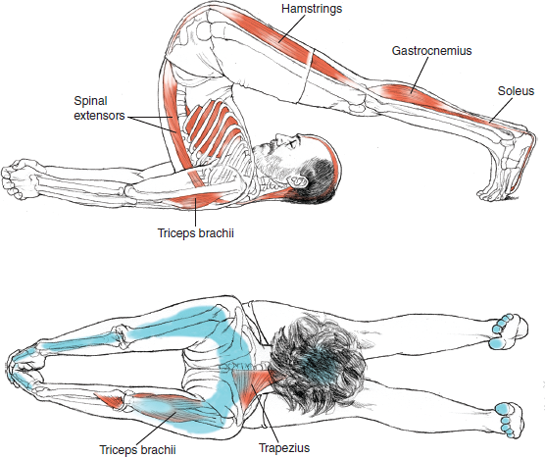
Joint Actions
The spine undergoes cervical, thoracic, and lumbar flexion, with the sacroiliac joint in nutation. The hips flex, adduct, and internally rotate, while the knees extend, and the ankles dorsiflex with toe extension. The scapulae adduct, downwardly rotate, and elevate. The glenohumeral joint externally rotates, extends, and adducts. The elbows extend, the forearms pronate, and the wrists extend as the fingers and hands flex to clasp.
Working
The spine engages similarly to Sarvangasana, but with greater activation in the intrinsic spinal muscles to maintain length. The neck muscles, including rectus capitis posterior major and minor and obliquus capitis superior and inferior, work eccentrically.
In the legs, gravity assists hip flexion, while the adductor magnus, gracilis, and pectineus maintain internal rotation and adduction against the pull of the gluteal muscles. The vastii extend the knees, while the tibialis anterior, extensor digitorum, and extensor hallucis extend the toes.
In the shoulders, muscles work more actively than in Sarvangasana to counteract the weight of the legs in hip flexion. The infraspinatus and teres minor externally rotate the humerus, while the subscapularis and coracobrachialis work eccentrically to prevent shoulder protraction. The long head of the triceps and teres major extend the shoulder and adduct the arm, while the posterior deltoid assists in extension and external rotation. The triceps extend the elbow, the forearm pronators activate, and the flexor carpi radialis, ulnaris, and flexor digitorum muscles engage to clasp the hands.
Lengthening
The spinal extensors stretch throughout the spine.
In the legs, the gluteus maximus, hamstrings, gastrocnemius, and soleus lengthen.
In the shoulders, the serratus anterior, coracobrachialis, pectoralis major, and pectoralis minor stretch.
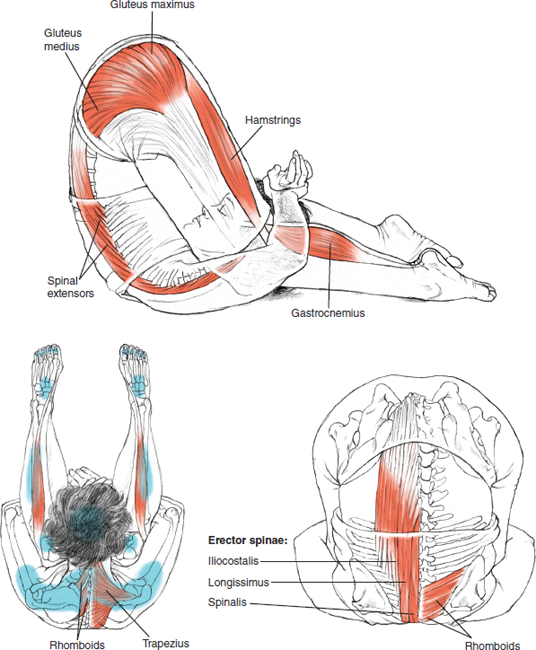
Joint Actions
The spine flexes, while the hips and knees also flex. The scapulae abduct and rotate upward. The arms flex, the elbows flex, and the hands press into the floor for support.
Working
Gravity primarily facilitates the pose, with slight engagement of the abdominal and hip flexor muscles to maintain balance and prevent rolling backward.
Lengthening
The spinal extensors stretch evenly to distribute the opening across the entire spine, preventing excessive strain on the neck and upper back. The rhomboids and trapezius lengthen due to scapular abduction and the pressure of the lower body into the upper back.
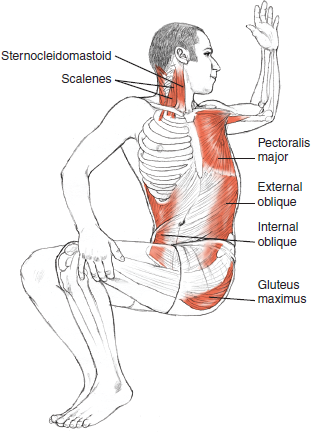
Joint Actions
The spine rotates axially, with the hips and knees flexed. The scapulae rest on the rib cage, while the far arm externally rotates and the near arm internally rotates.
Working
Gravity primarily facilitates the pose, with the spinal extensors engaging slightly to resist lumbar flexion.
Lengthening
In the top leg, the external obliques, intercostals, transversospinalis, gluteus medius, minimus, and maximus, along with the piriformis, gemelli, and obturator internus, lengthen. The bottom leg experiences lengthening in the internal obliques, intercostals, and oblique muscles of the erector spinae.
In the neck, the sternocleidomastoid stretches on the side the head turns toward, while the capitis posterior, obliquus capitis inferior, splenius capitis, rectus capitis anterior, and scalenes stretch on the opposite side.
In the arm the head turns toward, the pectoralis major and minor, coracobrachialis, latissimus dorsi, and brachial plexus nerve bundle lengthen.
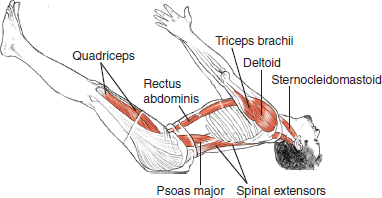
Joint Actions
The spine extends, while the hips experience mild flexion, adduction, and internal rotation. The knees extend, and the scapulae downwardly rotate and adduct. The glenohumeral joint extends, adducts, and internally rotates. The elbows flex, and the forearms pronate.
Working
The spinal extensors and lower fibers of the psoas major engage to maintain spinal extension.
In the legs, the psoas major, iliacus, pectineus, and tensor fascia latae contribute to hip flexion, while the hamstrings stabilize the legs, and the quadriceps assist in both hip flexion and knee extension.
In the arms, the subscapularis, teres major, and latissimus dorsi internally rotate the shoulders, with the latissimus dorsi and long head of the triceps also assisting in shoulder extension. The trapezius and rhomboids adduct the scapulae, while the forearm pronators turn the hands toward the floor.
Lengthening
The anterior neck muscles stretch, while the anterior rib cage expands with the internal intercostals lengthening. The abdominal muscles lengthen but work eccentrically to resist the forward displacement of the organs due to psoas activation. In the arms, the coracobrachialis, pectorals, long head of the biceps, serratus anterior, and anterior deltoids lengthen.
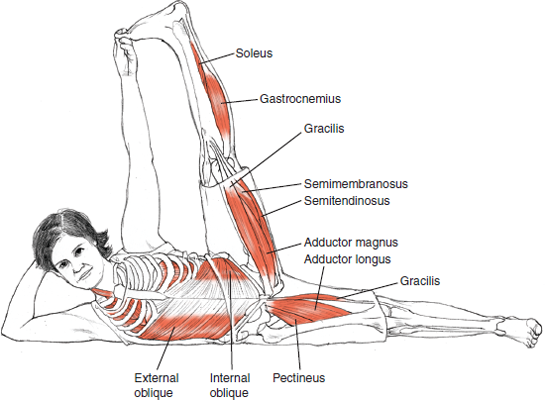
Joint Actions
The spine maintains its natural curves with lateral flexion. The lifted leg undergoes sacrum nutation, hip flexion, external rotation, abduction, knee extension, and ankle dorsiflexion. The bottom leg remains in hip neutral extension, internal rotation, and adduction, with knee extension, ankle dorsiflexion, and foot eversion for balance.
Working
The spine is stabilized by the obliques, with the internal obliques on the lifted leg side and external obliques on the opposite side resisting twisting.
In the top leg, the piriformis, obturator internus, and gemelli externally rotate and abduct the hip, while the posterior fibers of the gluteus medius and minimus assist in abduction. The quadriceps extend the knee, and the iliacus aids in hip flexion.
In the bottom leg, the hamstrings resist hip flexion caused by the lifted leg. The gluteus medius and minimus stabilize the pelvis, while the adductor magnus counteracts them to maintain pelvic balance.
Lengthening
In the top leg, the hamstrings, adductor magnus, gracilis, and pectineus stretch. In the bottom leg, the adductor longus, brevis, and gracilis lengthen.