Yoga Anatomy
Standing Poses
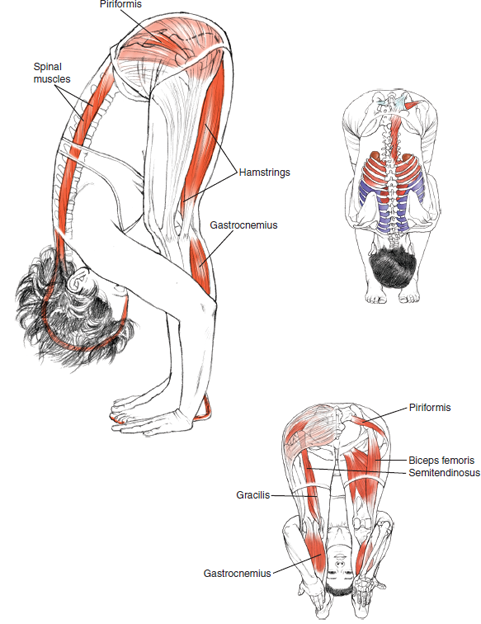
Joint Actions
Hip flexion, knee extension, mild spinal flexion (the tighter the hamstrings, the more the spinal flexion).
Working
Upper body: Gravity. Lower body: Vastus medialis, intermedius, lateralis (knee extensors); articularis genus (to draw up on the capsule of the knee joint); feet and ankles (for balance).
Lengthening
Spinal muscles, hamstrings, posterior fibers of gluteus medius and minimus, gluteus maximus, piriformis, adductor magnus, soleus, gastrocnemius.
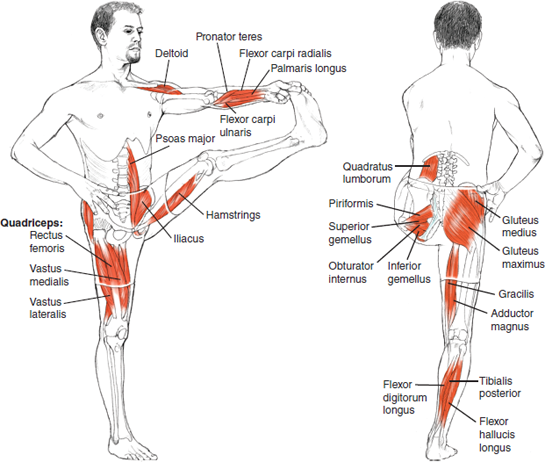
Joint Actions
Neutral spine, pelvis level, shoulder flexion, elbow extension, finger flexion. Standing leg: neutral hip extension, knee extension (not locked). Lifted leg: hip flexion, knee extension.
Working
Standing leg, spine, and pelvis: Quadriceps and hamstrings on the standing leg; spinal extensors, to keep from flexing the spine and tucking the pelvis; abductors and external rotators, eccentrically, to keep the pelvis level; external and internal obliques; rotary muscles of the back (obliques, transversospinalis), to counter the rotation created by the arm holding the toe. Lifted leg: Flexors of the shoulder and fingers to hold the big toe and create hip flexion; psoas major and iliacus, rectus femoris, pectineus, adductor brevis and longus (to help with hip flexion).
Lengthening
Lifted leg: Hamstrings, gastrocnemius, soleus, gluteus maximus.
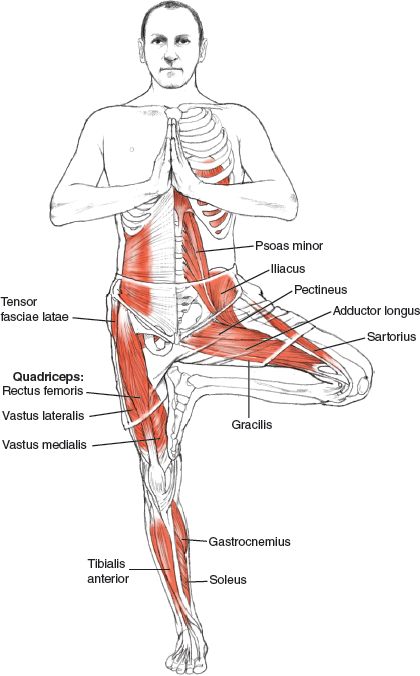
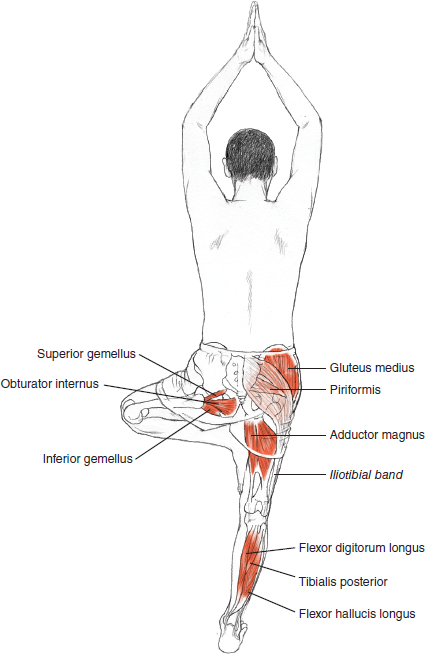
Joint Actions
Neutral spine, level pelvis. Standing leg: hip neutral extension, internal rotation, adduction; knee extension (not locked). Lifted leg: hip flexion, external rotation, abduction; knee flexion; tibia external rotation; ankle dorsiflexion (pressed against the adductors of the standing leg); foot pronation.
Working
Lifted leg: Iliacus and psoas major, all external rotators and extensors—gluteus maximus, posterior fibers of gluteus medius and minimus, piriformis, adductor magnus (extensor portion), obturator internus and externus, gemelli, quadratus femoris. Standing leg: Piriformis, tensor fascia lata, gluteus medius and minimus, gluteus maximus (extensor portion). Standing foot: Intrinsic muscles of the foot, muscles of the ankle and lower leg.
Lengthening
Lifted leg: Pectineus, adductor longus and brevis, gracilis. Standing leg: Gluteus medius and minimus, piriformis (working eccentrically).
Joint Actions
Neutral spine; scapula upward rotation, abduction, elevation; glenohumeral external rotation, abduction; elbow extension; forearm pronation (if the upper arm is externally rotated).
Working
Infraspinatus, teres minor, deltoids, supraspinatus, long head biceps, serratus anterior (supported by the upper fibers of the trapezius), triceps with anconeus to extend elbows.
Lengthening
Latissimus dorsi, teres major, long head triceps.
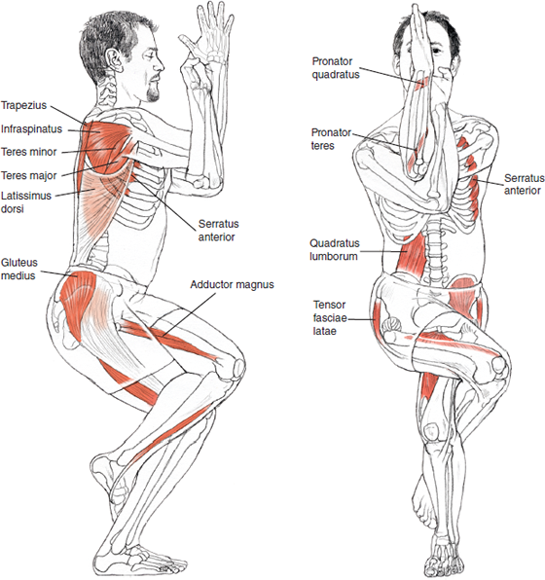
Joint Actions
Mild spinal flexion; scapula abduction, upward and lateral rotation, elevation; glenohumeral external rotation; elbow flexion; forearm pronation; neutral wrist extension; pelvis anterior tilt, counternutation; hip flexion, internal rotation, adduction; knee flexion, internal rotation; ankle dorsiflexion; foot—lifted in eversion, standing in slight supination.
Working
Arm position: Infraspinatus (both working and lengthening), serratus anterior, pectoralis major and minor, coracobrachialis, pronator teres and pronator quadratus. Leg position: Gluteus medius and minimus (anterior fibers), tensor fascia latae, adductor magnus, gluteus medius and minimus also working to stabilize the standing hip.
Lengthening
Arm position: Because of the abduction of the scapulae—rhomboids, lower trapezius, teres major, and latissimus dorsi (slightly); infraspinatus, triceps (slightly). Leg position: Gluteus maximus, piriformis, quadratus femoris, obturator internus, posterior fibers of gluteus medius and minimus.
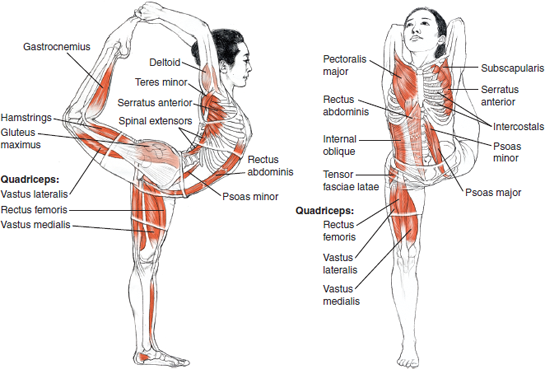
Joint Actions
Spinal extension; scapula upward rotation, abduction, and elevation; arm flexion; elbow flexion; and forearm supination. Standing leg: hip flexion, knee extension, and ankle dorsiflexion. Lifted leg: hip extension, knee flexion, and ankle plantarflexion.
Working
Arms: The serratus anterior works to wrap the scapula around the rib cage; the infraspinatus and teres minor externally rotate the glenohumeral joint; and the deltoids lift the arms into position. The supraspinatus and subscapularis are also active to help hold the head of the humerus in its socket. Spine: The intrinsic extensor muscles of the spine—intertransversarii, interspinalis, rotatores, multifidi, spinalis, semispinalis, splenius capitis and cervicis, longissimus, and iliocostalis—are all active in creating and maintaining spinal extension. The psoas minor, rectus abdominis, and obliques should all work eccentrically against the action of the spinal extensors to prevent too much action in the lumbar spine, and move more action into thoracic spinal extension and hip extension. Standing leg: The gluteus medius and minimus and the tensor fascia latae work eccentrically to keep the pelvis level. The quadriceps extend the knee, and the hamstrings lengthen (if there’s enough range of motion in the hamstrings, they might work eccentrically to resist tipping too far forward). The muscles of the feet and forelegs are active for balance. Lifted leg: The hamstrings create hip extension and knee flexion, and the vastii come into isometric or concentric action as knee extensors as the pose deepens, to increase the hip extension against the resistance of the hand on the foot. The adductor magnus is active as both an adductor and hip extensor, and the gluteus maximus (though not as an external rotator).
Lengthening
Arms: Rhomboids, latissimus dorsi, triceps, pectoralis major. Spine: Rectus abdominis, obliques, intercostals. Standing leg: Hamstrings, abductors (working eccentrically). Lifted leg: Iliacus, psoas major, rectus femoris.
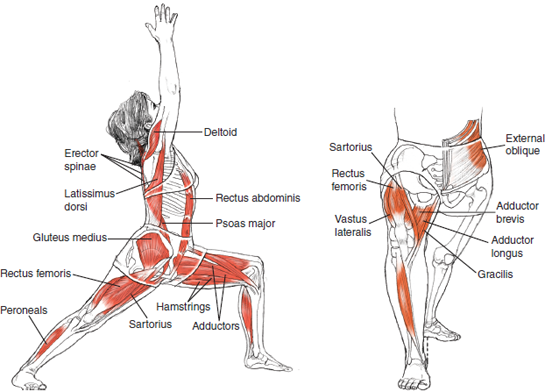
Joint Actions
Spinal extension; shoulder flexion, slight abduction of scapulae. Front leg: nutation, hip flexion, knee flexion, ankle dorsiflexion. Back leg: counternutation, hip extension (internal rotation), knee extension, ankle dorsiflexion and supination (to keep the heel grounded and the arch lifted).
Working
Spinal extensors, serratus anterior, deltoids, teres minor, infraspinatus, rectus abdominis (eccentrically), left internal obliques and right external obliques, psoas minor, anterior neck (rectus capitis, longus capitis, longus colli, verticalis, scalenes [eccentrically]). Front leg: hamstrings and quadriceps, eccentrically. Back leg: hamstrings and quadriceps, concentrically.
Lengthening
Latissimus dorsi, rectus abdominis, pectoralis major and minor, anterior neck (rectus capitis, longus capitis, longus colli, verticalis, scalenes). Front leg: hamstrings and quadriceps, slightly. Back leg: rectus femoris, vastii, psoas major, iliacus, soleus, and gastrocnemius.
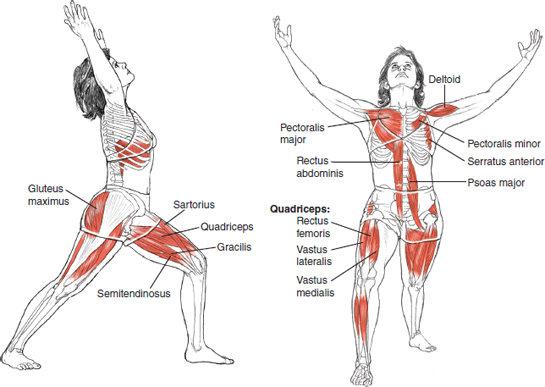
Joint Actions
Same as basic warrior but with deeper lumbar extension against anterior tilt of pelvis, adduction of legs, more supination in back foot, adduction of arms, more rotation in spine.
Working
Spinal extensors (intrinsics, transversospinalis, erector spinae), anterior and middle deltoids, serratus anterior, pectoralis major and minor, upper trapezius, rectus abdominis. Front leg: hamstrings eccentrically, adductors, gluteus medius and minimus. Back leg: hamstrings concentrically, gluteus medius and minimus, peroneals, quadriceps, sartorius.
Lengthening
Latissimus dorsi, rhomboids, rectus abdominis, external obliques. Front leg: quadriceps (at knee joint), hamstrings (at hip joint), gluteus medius and minimus. Back leg: peroneals, gluteus medius and minimus, psoas major, rectus femoris (at hip joint).
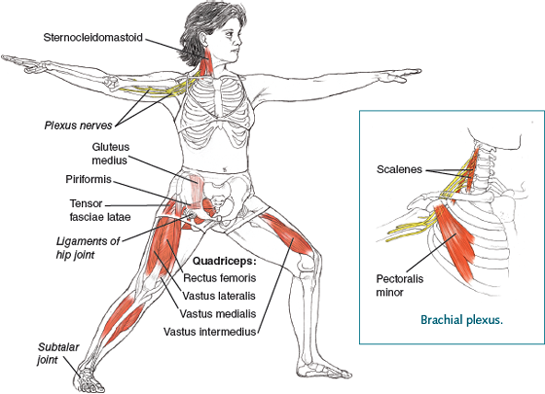
Joint Actions
Spine in neutral extension; head rotated on axis; scapula upward rotation; upper arm abduction, external rotation; forearm pronation (opposing spirals in arms). Front leg: nutation; hip flexion, external rotation, abduction; knee flexion; ankle dorsiflexion. Back leg: counternutation; hip extension, internal rotation, abduction; knee extension, external rotation at tibia; ankle dorsiflexion; foot supination at heel, pronation at forefoot (arch lifted, big toe grounded).
Working
Back hip joint: Primarily gluteus medius and minimus, for internal rotation and abduction; gluteus maximus and hamstrings, for extension; tensor fascia latae, for internal rotation; pectineus for internal rotation; vastii, to extend knee. Front hip joint: Hamstrings and quadriceps (eccentrically), gluteus maximus, piriformis, obturator internus and externus, quadratus femoris, gemelli, gluteus medius and minimus (posterior fibers).
Lengthening
Back hip joint: Tensor fascia lata, iliopsoas. Front hip joint: Hamstrings and quadriceps (vastii).
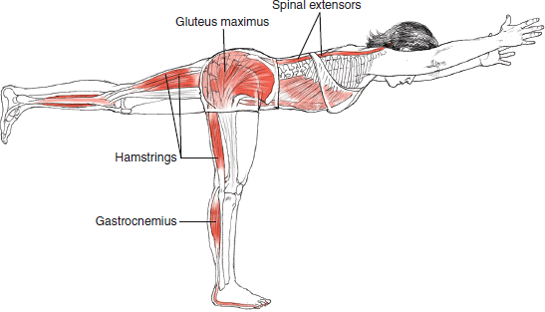
Joint Actions
Spine axial extension, shoulder flexion and lateral rotation, elbow extension, forearm supination, finger extension. Front leg: nutation, hip flexion and adduction, knee extension, and ankle dorsiflexion. Back leg: counternutation, hip neutral extension and medial rotation, knee extension, ankle dorsiflexion.
Working
Spinal extensors against gravity, abdominal muscles and psoas minor to maintain a neutral spine. Both legs’ hamstrings: standing leg eccentrically, back leg concentrically against gravity. Standing leg abductors: eccentrically to maintain level pelvis; standing leg gluteus maximus, deep rotators eccentrically to maintain level pelvis.
Lengthening
Standing leg hamstrings, standing leg abductors, gluteus maximus, deep external rotators.
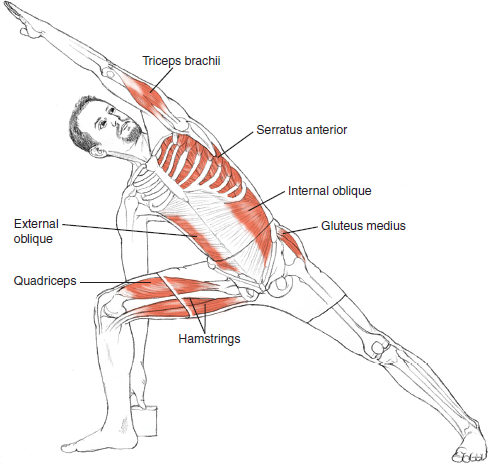
Joint Actions
Spine neutral or with slight lateral flexion; shoulder abduction, upward rotation; glenohumeral joint flexion and external rotation; elbow extension. Front leg: nutation; hip flexion, external rotation, abduction; knee flexion; ankle dorsiflexion. Back leg: counternutation; hip extension, internal rotation, abduction; knee extension (external rotation at tibia); ankle dorsiflexion; foot supination at heel; pronation at forefoot.
Working
Front leg (compare to virabhadrasana II): With increased hip flexion, the eccentric action of the hamstrings and vastii become more important—the hamstrings because they are resisting the weight of the spine over the front leg and are working at greater length, and the vastii because the rectus femoris is shortened and less effective with greater hip flexion. Upper side (arm, spine, and back leg): Serratus anterior, deltoids, triceps, lower side external obliques, upper side internal obliques. In the back leg, the action is similar to virabhadrasana II: primarily gluteus medius and minimus (the anterior fibers help with internal rotation, the posterior fibers with abduction); gluteus maximus, for extension (but not external rotation); tensor fascia lata, for internal rotation (but not flexion); pectineus for internal rotation (but not flexion); hamstrings (more semimembranosus); quadriceps to extend the knee (more vastii than rectus femoris).
Lengthening
Front leg: Hamstrings, gluteus maximus, piriformis, obturator internus, gemelli, gluteus medius and minimus, gastrocnemius, soleus. Back leg: Tensor fascia lata, iliopsoas.
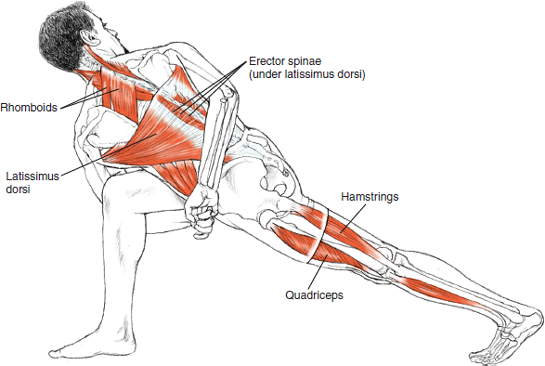
Joint Actions
Spinal axial rotation; scapula downward (medial) rotation; adduction right arm (abduction initially, then adduction in left arm as well); glenohumeral joints internal rotation, extension, adduction; elbow extension. Front leg: nutation, hip flexion and adduction, knee flexion, ankle dorsiflexion. Back leg: hip extension and adduction, knee extension.
Working
The spinal rotation works the erector spinae and internal obliques on the side of the torso closer to the ceiling and the transversospinalis and rotatores and external obliques on the side of the torso closer to the front leg. All spinal extensors are active to counter the spinal flexion created by the action of the arms.
Lengthening
The arm binding works the supraspinatus to hold the head of the humerus in the socket, subscapularis, teres major, latissimus dorsi, and rhomboids, while lengthening the upper trapezius, pectoralis major, pectoralis minor, serratus anterior, supraspinatus, infraspinatus, teres minor, anterior deltoid, and coracobrachialis.
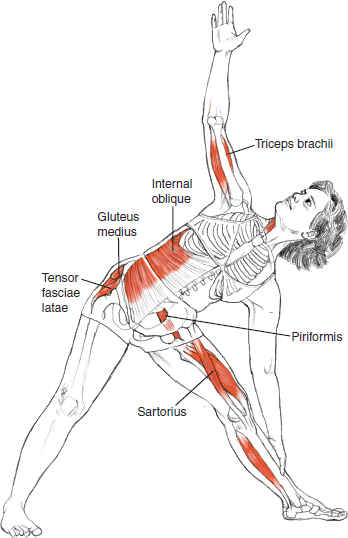
Joint Actions
Spine neutral extension, slight rotation (but not much lateral extension); head axial rotation; upper limbs abduction, external rotation. Front leg: hip external rotation, flexion, abduction; knee extension; slight ankle plantarflexion; slight foot pronation. Back leg: hip internal rotation, adduction, extension; knee extension; foot supination.
Working
Front leg: Iliacus, psoas major, piriformis, obturator internus (also as abductors), quadratus femoris, obturator externus, gemelli, gluteus medius and minimus, gluteus maximus (external rotation and abduction fibers), sartorius, hamstrings. Back leg: Anterior fibers of gluteus medius and minimus, adductor magnus, gluteus maximus, pectineus, tensor fascia lata, semitendinosus, semimembranosus, biceps femoris.
Lengthening
Front leg: Quadratus femoris and obturator externus (working eccentrically as adductors), gemelli, pectineus, gracilis, adductor magnus and minimus, adductor longus and brevis, semitendinosus, semimembranosus, biceps femoris. Back leg: Gluteus medius and minimus (eccentrically), gluteus maximus, sartorius, biceps femoris (eccentrically).
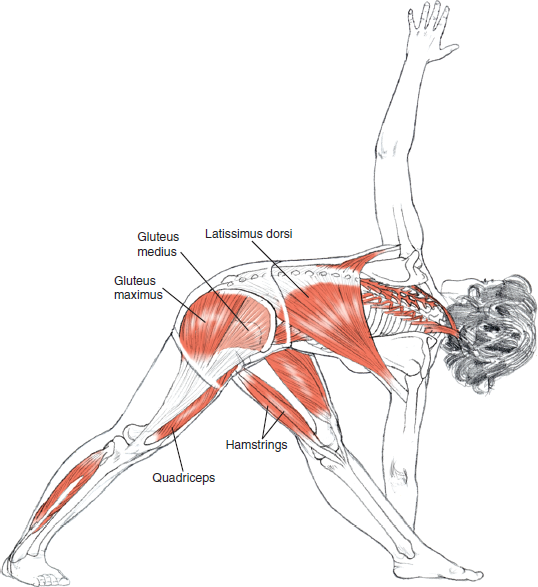
Joint Actions
Spine: Neutral extension, axial rotation. Upper limbs: Abduction, external rotation, elbow extension. Front leg: Hip flexion, adduction, external rotation; knee extension; ankle slight plantarflexion. Back leg: Hip mild flexion, internal rotation; knee extension; ankle dorsiflexion; foot supinated at heel, pronated at forefoot.
Working
Transversospinalis group (especially multifidi), erector spinae group, internal and external obliques—to maintain neutral extension in the spine against the pull of gravity and the muscular efforts of the leg and pelvis.
Lengthening
Working while lengthening: Gluteus medius and minimus, quadratus femoris, obturator internus and externus, gemelli, piriformis. Lengthening and releasing: Gluteus maximus, hamstrings, latissimus dorsi, teres major.
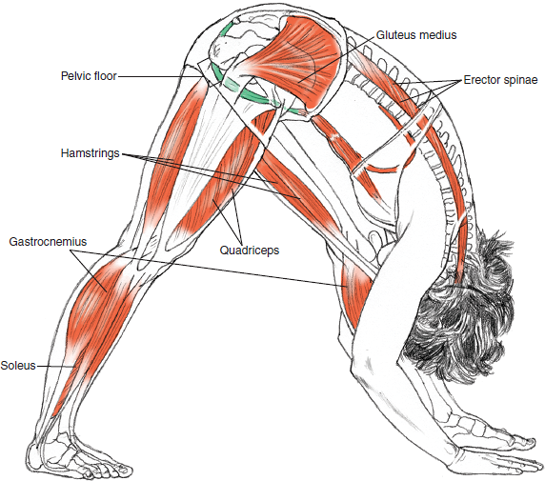
Joint Actions
Spine flexion (mild); nutation in front leg; counternutation in back leg. Front leg: deep hip flexion, knee extension, ankle dorsiflexion. Back leg: hip flexion, medial rotation; knee extension; deep dorsiflexion in ankle.
Working
Pelvic floor (to articulate sitting bones), quadriceps and articularis genus, abductors (gluteus medius and minimus for balance), feet and lower leg muscles (for balance).
Lengthening
Hamstrings (especially front leg), gluteus maximus (especially front leg), soleus and gastrocnemius (back leg), abductors, spinal erector muscles.
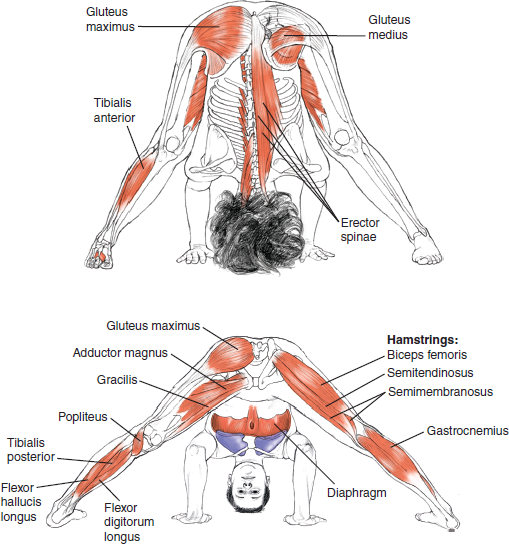
Joint Actions
Flexion and abduction at hips, knee extension, mild spinal flexion, mild medial rotation at hips or knees, pronation and supination at feet for balance.
Working
Quadriceps and articularis genus (concentrically to bring knees into extension and keep kneecaps lifted); adductors (eccentrically, working against the body weight falling toward the floor); abductors (concentrically, to undo the knees falling inward and arches dropping); intrinsic and extrinsic muscles of the feet (to direct the weight through the calcaneus and not only the outer edge of the foot; the balance of supination and pronation is similar to the back leg in asymmetrical standing poses).
Lengthening
As the legs separate (abduct), different hamstrings are affected more or less strongly as well as different adductors. Because some of the adductors also act as hip flexors, they aren’t stretched in this position.