Yoga Anatomy
Sitting Poses
Joint Actions
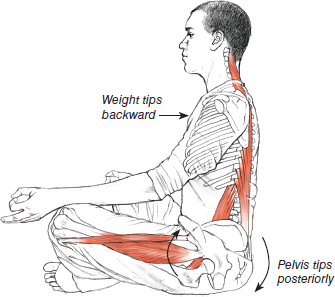
The spine moves toward extension with sacral nutation. The hips flex, adduct, and internally rotate, while the knees extend and the ankles slightly dorsiflex. The shoulders engage in scapular abduction and upward rotation, with elbow extension and slight forearm pronation.
Working
Gravity helps draw the torso toward the thighs. Spinal extensors support the posture by deepening hip flexion. The vastii and articularis genus assist in knee extension.
Lengthening
The spinal extensors and latissimus dorsi lengthen. The legs experience stretching in the hamstrings, glutes, deep hip rotators, and calf muscles. The popliteus eccentrically prevents knee hyperextension. The rhomboids, trapezius, and latissimus dorsi lengthen in the arms.
Joint Actions
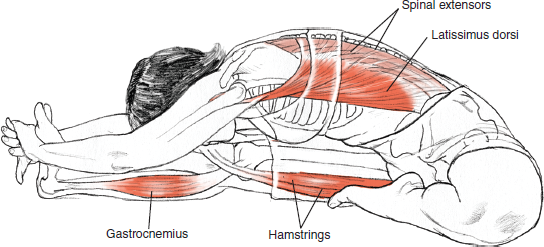
The spine undergoes mild flexion and slight rotation. The extended leg flexes at the hip with internal rotation and knee extension, while the folded leg flexes, externally rotates, and abducts. The shoulders and arms engage in scapular abduction, upward rotation, and elbow extension.
Working
Spinal extensors deepen hip flexion, while obliques and deep spinal muscles rotate the spine toward the extended leg. Gravity aids hip flexion, with knee extensors supporting the extended leg. The folded leg's position is maintained by external rotators, sartorius, hamstrings, and tibialis anterior.
Lengthening
The spinal extensors, latissimus dorsi, and obliques stretch along with the deep spinal muscles. The extended leg experiences stretching in the hamstrings, glutes, and calf muscles, while the folded leg lengthens the adductors, pectineus, TFL, and gluteus medius/minimus. The arms stretch the rhomboids, trapezius, and latissimus dorsi.
Joint Actions
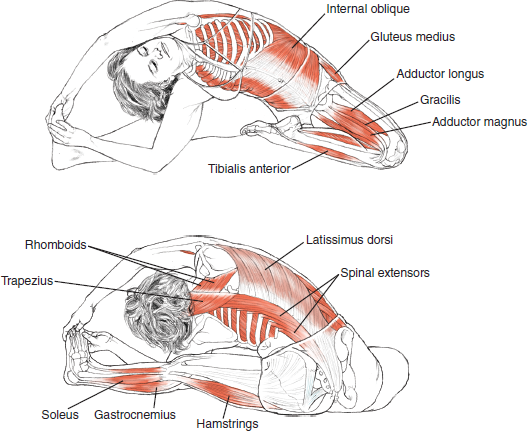
This pose involves spinal rotation and lateral flexion. The extended leg flexes at the hip with slight internal rotation, while the folded leg flexes, externally rotates, and abducts. The shoulders and arms engage in scapular upward rotation, elevation, and adduction, with elbow extension and forearm supination.
Working
Gravity pulls the torso into lateral flexion. The obliques, rotatores, and multifidi guide spinal rotation. The extended leg's hip flexion is aided by gravity, while knee extension is supported by the vastii. The folded leg's external rotation and flexion involve the sartorius, hamstrings, and deep hip rotators.
Lengthening
The top-side spinal extensors, quadratus lumborum, and latissimus dorsi stretch, along with the external obliques and deep spinal muscles. The extended leg lengthens the hamstrings, glutes, and calf muscles, while the folded leg stretches the adductors, pectineus, and tensor fascia lata. The arms stretch the rhomboids, trapezius, and latissimus dorsi.
Joint Actions
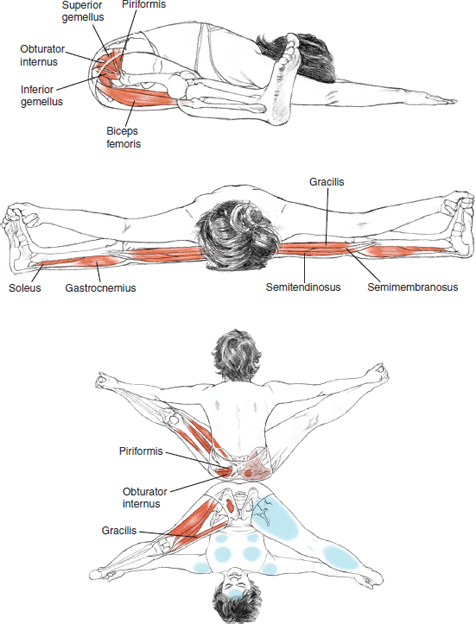
The spine moves toward axial extension with mild flexion and sacral nutation. The hips undergo major abduction, external rotation, and flexion, while the knees extend and the ankles dorsiflex.
Working
The gemelli and obturator internus drive both external rotation and abduction, assisted by the piriformis, gluteus maximus, and deep hip rotators. The spinal extensors remain active to maintain an elongated spine as the pose deepens.
Lengthening
The piriformis, gluteus maximus, obturator externus, and quadratus femoris lengthen eccentrically. The gracilis stretches due to knee extension, while the semitendinosus and semimembranosus lengthen with hip abduction. The gastrocnemius stretches when assisting ankle dorsiflexion. The spinal extensors lengthen while staying engaged to support the posture.
Joint Actions
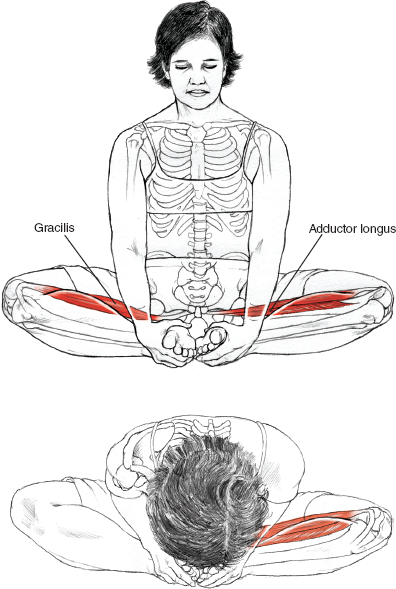
The spine remains in neutral extension when upright and moves into mild flexion when folding forward. The sacroiliac joint nutates, while the hips flex and externally rotate. The knees flex, the ankles dorsiflex, and the feet supinate. The shoulders remain neutral, with external rotation at the glenohumeral joint, elbow flexion, and forearm supination.
Working
The spinal muscles, including the erector spinae and deep stabilizers, maintain neutral extension, while gravity assists in forward flexion. The obturator externus, quadratus femoris, and deep hip rotators externally rotate the hips, while the hamstrings and sartorius contribute to knee flexion and hip positioning. The serratus anterior and rhomboids stabilize the scapulae, while the biceps and finger flexors assist in holding the feet.
Lengthening
The adductor magnus, longus, brevis, and gracilis stretch due to hip abduction, with gracilis lengthening further as the knees extend. The tensor fascia latae, gluteus medius, and minimus also lengthen with increased hip flexion. The hamstrings experience greater stretch as the feet move forward and the knees extend.
Joint Actions
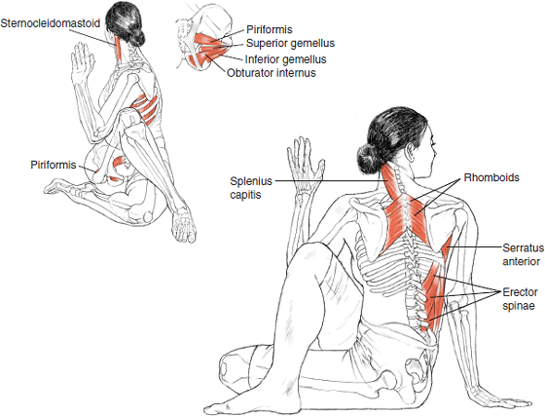
The spine rotates toward the top leg while maintaining neutral extension. The top leg undergoes deep hip flexion, adduction, and internal rotation, with knee flexion. The bottom leg has moderate hip flexion, adduction, and external rotation, also with knee flexion. The front arm rests on the top leg with scapula neutral, slight abduction, and elbow flexion, while the back arm extends with scapula neutral and wrist dorsiflexion.
Working
The spinal muscles engage to maintain extension and resist flexion, with the internal obliques and erector spinae on the top leg side facilitating rotation, while the external obliques, rotatores, and multifidi on the bottom leg side assist in stabilizing the twist. The adductors and internal rotators of the top leg maintain its position, while the hamstrings support knee flexion in the bottom leg. The arms work to stabilize the pose, with rhomboids, infraspinatus, and teres minor assisting in shoulder and scapular placement.
Lengthening
The spinal extensors, obliques, and deep rotators stretch depending on the side of rotation. The piriformis, gluteus medius, minimus, and other deep hip muscles lengthen due to adduction and internal rotation in the top leg and hip flexion in the bottom leg. The front arm may experience eccentric rhomboid activation, while the back arm stretches the pectorals, biceps, and coracobrachialis.
Joint Actions
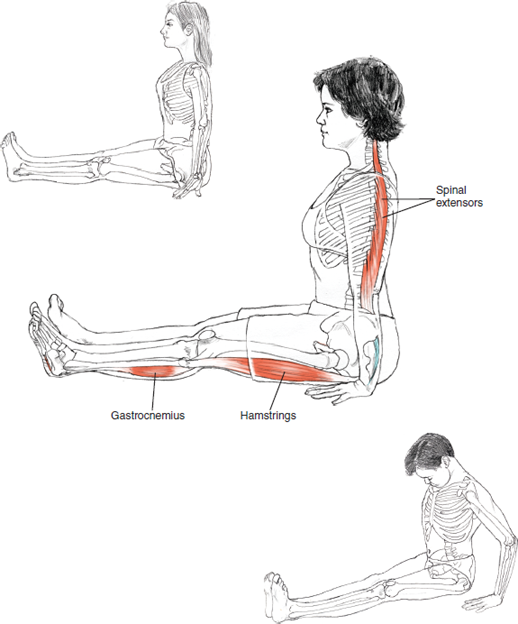
The spine remains neutral or in axial extension, with the sacroiliac joint in a neutral position. The hips flex to 90 degrees with slight adduction and internal rotation, while the knees extend and the ankles dorsiflex. The scapulae stay neutral, the shoulders remain in neutral extension, and the elbows and wrists extend.
Working
The spinal extensors, psoas major, and minor maintain spinal alignment. The iliacus flexes the hips, while the pectineus and adductor magnus aid in adduction and internal rotation. The vastii extend the knees. The serratus anterior stabilizes the scapulae, and the triceps extend the elbows. The wrist flexors support the hand’s position, preventing excessive flexion.
Lengthening
The hamstrings, gluteus maximus, and deep hip rotators stretch, along with the gluteus medius, minimus, gastrocnemius, and soleus. The popliteus works eccentrically to prevent knee hyperextension. Depending on arm length, the biceps may also lengthen.
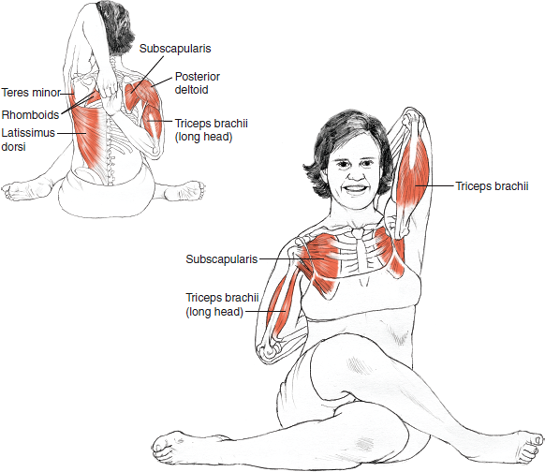
Joint Actions
The spine remains mostly neutral with slight thoracic extension due to the arm position. The top arm undergoes scapular upward rotation, elevation, and adduction, with external rotation and flexion at the shoulder. The bottom arm experiences scapular downward rotation, adduction, and depression, with internal rotation and extension at the shoulder. The hips flex, externally rotate, and adduct, while the knees flex and the ankles plantarflex.
Working
The legs and hips are released into gravity as much as possible. The top arm engages the infraspinatus and teres minor for external rotation, the serratus anterior for scapular movement, and the anterior deltoid for arm flexion. The bottom arm uses the subscapularis, teres major, and latissimus dorsi for internal rotation and extension, with the triceps and posterior deltoid assisting. The biceps and supinators work to flex the elbow and position the forearm.
Lengthening
The hip abductors (gluteus medius, minimus, maximus) and extensors (adductor magnus, hamstrings) stretch, along with the piriformis due to hip flexion and adduction. The top arm stretches the triceps, latissimus dorsi, teres major, and pectorals, while the bottom arm experiences lengthening in the deltoids and chest muscles.
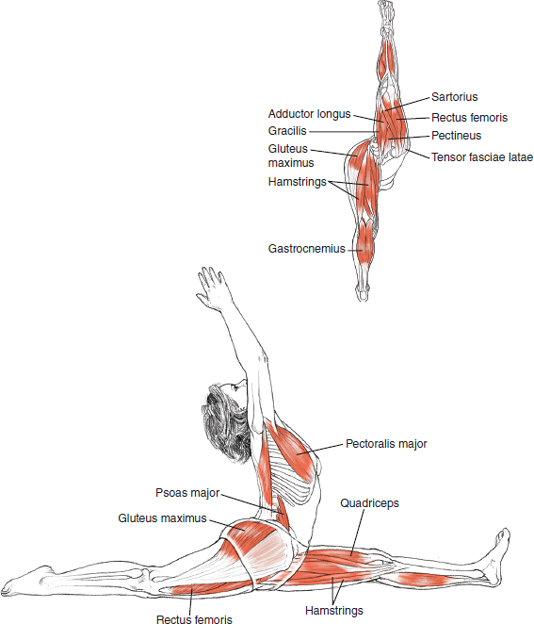
Joint Actions
The spine extends while the front leg undergoes sacral nutation, hip flexion, internal rotation, and adduction, with knee extension and neutral ankle extension. The back leg experiences sacral counternutation, hip extension, internal rotation, and adduction, with knee extension and plantarflexion. The scapula rotates upward, elevates, and abducts, with the glenohumeral joint flexing, adducting, and externally rotating. The elbow extends and the forearm remains neutral.
Working
The arms engage the serratus anterior to wrap the scapula, anterior deltoid for arm flexion, infraspinatus and teres minor for external rotation, and the biceps and triceps to manage arm movement. Gravity deepens the stretch, but muscles like the spinal extensors and those listed as lengthening also stabilize eccentrically. In the front leg, the hamstrings, gluteus maximus, gastrocnemius, and soleus work eccentrically, while the articularis genus and quadriceps help with knee extension. In the back leg, the psoas major and iliacus stabilize eccentrically.
Lengthening
The spine lengthens in the obliques, psoas minor, rectus abdominis, intercostals, and deep neck muscles. The front leg’s hamstrings, gluteus maximus, piriformis, deep hip rotators, gastrocnemius, and soleus lengthen. The back leg stretches the psoas major, iliacus, rectus femoris, sartorius, tensor fascia lata, and adductors, with less strain on the adductors if the back leg is more internally rotated.
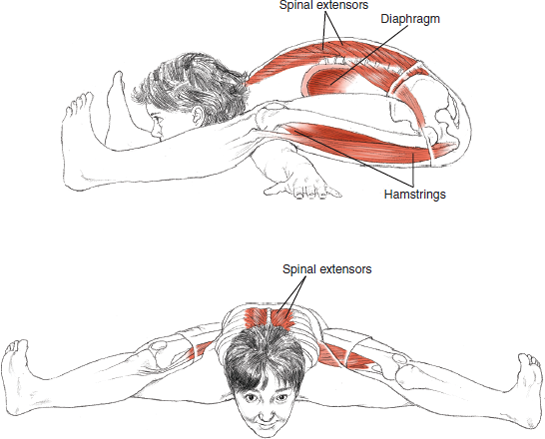
Joint Actions
The cervical spine extends, and the thoracic and lumbar spine flex, moving toward extension. The sacroiliac joint nutates, and the hips flex, abduct, and remain in neutral rotation. The knees extend, and the ankles dorsiflex. The scapulae elevate, rotate downward, and abduct, moving toward adduction and lateral rotation. The glenohumeral joint moves into lateral abduction and internal rotation, while the elbows extend, and the forearms pronate.
Working
Gravity pulls the torso toward the floor. Spinal extensors deepen hip flexion as the arms press against the legs. The hamstrings activate to extend the hips, while the vastii help extend the knees. The rhomboids and trapezius adduct the scapulae, and the posterior deltoids press the arms into the legs. The biceps resist hyperextension of the elbows.
Lengthening
In the legs, the piriformis, gluteus maximus, obturator externus, and quadratus femoris lengthen eccentrically, while the gracilis stretches due to knee extension. The semitendinosus and semimembranosus are particularly lengthened due to hip abduction. In the spine, the spinal extensors lengthen as the pose deepens into thoracic extension. The rhomboids lengthen initially and then contract to reposition the scapulae.
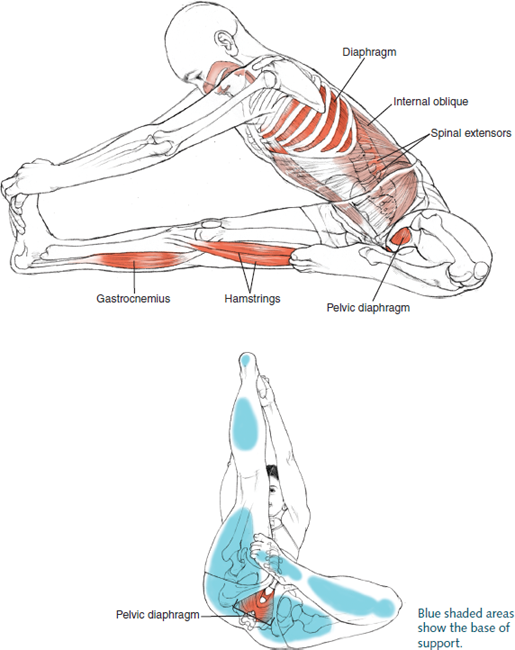
Joint Actions
Spine: Atlanto-occipital flexion, axial extension, mild thoracic rotation. Extended leg: Hip flexion, adduction, internal rotation, knee extension, ankle dorsiflexion. Folded leg: Hip flexion, abduction, external rotation, knee flexion, ankle plantarflexion. Shoulders and arms: Scapular upward rotation, glenohumeral flexion and adduction, elbow extension, forearm pronation.
Working
Spine: Extensors resist gravity, internal and external obliques rotate the spine. Bandhas: Mula (pelvic floor), Uddiyana (rib cage), Jalandhara (chin lock). Legs: Psoas, iliacus, adductors, vastii, and hamstrings for hip and knee positions. Arms: Serratus anterior, deltoids, pectoralis major, triceps, and hand muscles.
Lengthening
Spine: Posterior suboccipitals, sternocleidomastoids. Extended leg: Hamstrings, gluteus maximus, piriformis, gastrocnemius, soleus. Folded leg: Adductors, gluteus medius, minimus, tensor fascia lata. Arms: Rhomboids, trapezius, latissimus dorsi.
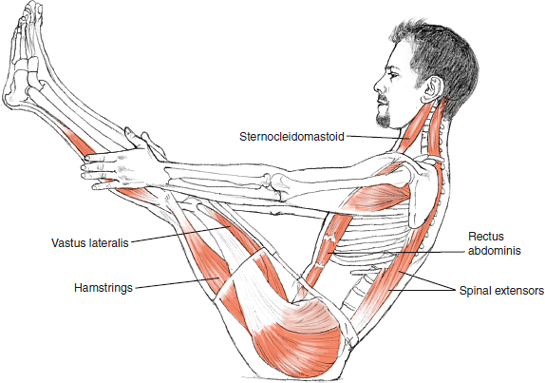
Joint Actions
The spine maintains neutral extension, resisting flexion, while the sacroiliac joint stays neutral, resisting counternutation. The hips flex, adduct, and internally rotate, with knee extension and ankle neutral extension. If the arms are extended to shoulder height, the scapula remains neutral, the glenohumeral joint flexes, laterally adducts, and slightly externally rotates, and the forearms remain in neutral rotation.
Working
The psoas major and spinal extensors work to maintain neutral spinal alignment, while the abdominal muscles resist lumbar hyperextension and prevent the abdominal organs from bulging forward under the weight of the torso and arms. The psoas major, iliacus, and rectus femoris flex the hips, while the vastii extend the knees. The gracilis, pectineus, sartorius, and tensor fascia latae assist in hip flexion, internal rotation, and adduction. The serratus anterior and rhomboids stabilize the scapulae, while the infraspinatus and teres minor externally rotate the humerus. The anterior deltoids and coracobrachialis flex and laterally adduct the arms, and the triceps and anconeus extend the elbows.
Lengthening
The hamstrings lengthen as the legs are held in position.
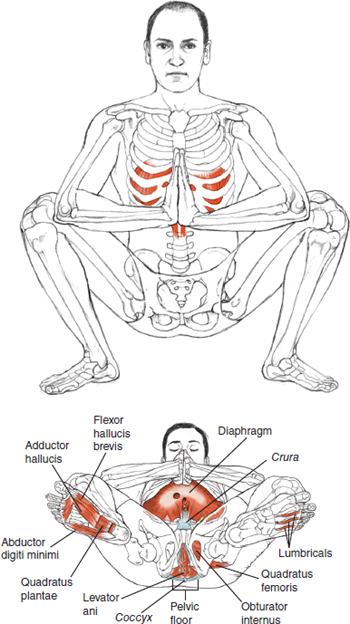
Joint Actions
Spinal axial extension; glenohumeral joint external rotation, adduction; elbow flexion; forearm pronation; wrist dorsiflexion; sacrum nutation; hip flexion, external rotation, abduction; knee flexion; ankle dorsiflexion.
Working
Pelvic floor: Obturator internus, levator ani. Isometrically: piriformis, obturator externus, two gemelli, quadratus femoris, biceps femoris, semitendinosus, semimembranosus, adductor magnus (long head). The legs should stay active; otherwise the deep flexion tends to collapse the hip joints, making it more challenging to activate the pelvic floor. Foot: Lumbricals, quadratus plantae, adductor hallucis, flexor hallucis brevis, flexor digitorum brevis, opponens and flexor digiti minimi, abductor digiti minimi.
Lengthening
Adductor longus, adductor brevis, hamstrings, gastrocnemius, soleus, plantaris (not the gracilis, because of knee flexion).