Yoga Anatomy
Kneeling Poses
Joint Actions
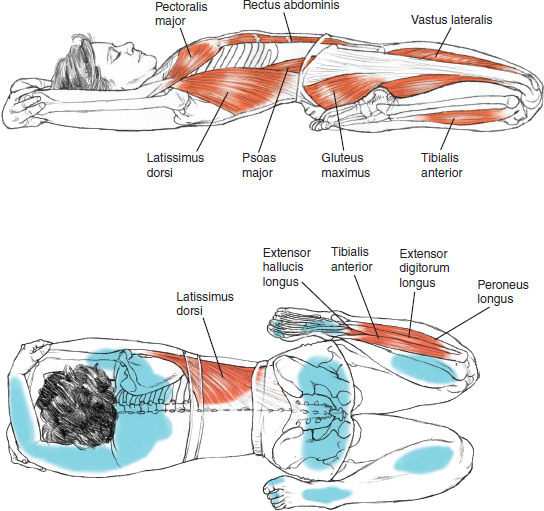
The spine is in axial extension (in the full version of the pose), with the sacroiliac joint in counternutation. The hips extend, internally rotate, and adduct, while the knees flex and the tibia medially rotates. The ankles are plantarflexed. The scapula rotates upward, abducts, and elevates. The glenohumeral joint flexes and externally rotates, while the elbows flex.
Working
Suptavirasana is a relaxing hip opener where gravity helps release tension. The lower abdominal muscles can be activated to prevent lumbar hyperextension and assist in lengthening the psoas major.
Lengthening
The rectus abdominis, lower psoas major, iliacus, rectus femoris, sartorius, tensor fascia latae, gluteus medius and minimus, vastii, tibialis anterior, extensor digitorum longus, and extensor hallucis longus lengthen. The piriformis, gemelli, and obturator internus stretch due to internal rotation and adduction, while the adductors and pectineus lengthen from hip extension.
Joint Actions
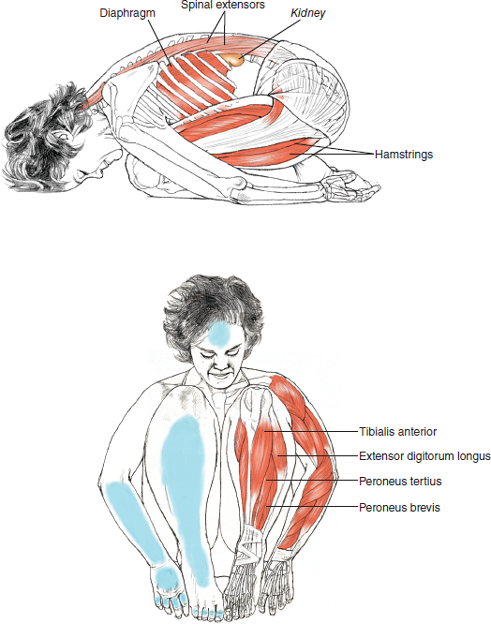
The spine is in full flexion, with slight cervical extension depending on head position. The hips flex with neutral rotation and adduction, the knees flex, and the ankles plantarflex. The scapulae abduct and rotate downward, while the glenohumeral joint internally rotates. The elbows extend, and the forearms pronate.
Working
Gravity helps deepen the stretch as the body yields into the position.
Lengthening
To bring the sitting bones to the heels and the forehead to the floor, the extensors of the spine, gluteus maximus, piriformis, and other hip rotators lengthen. The hamstrings, gluteus medius and minimus (due to hip adduction), tibialis anterior, peroneus tertius, extensor digitorum longus and brevis, and extensor hallucis longus and brevis in the feet also lengthen.
Joint Actions
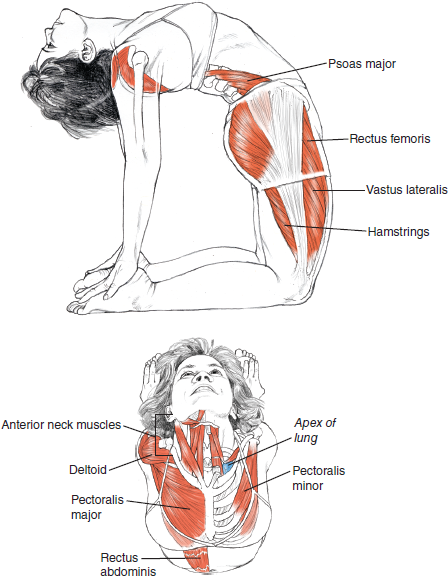
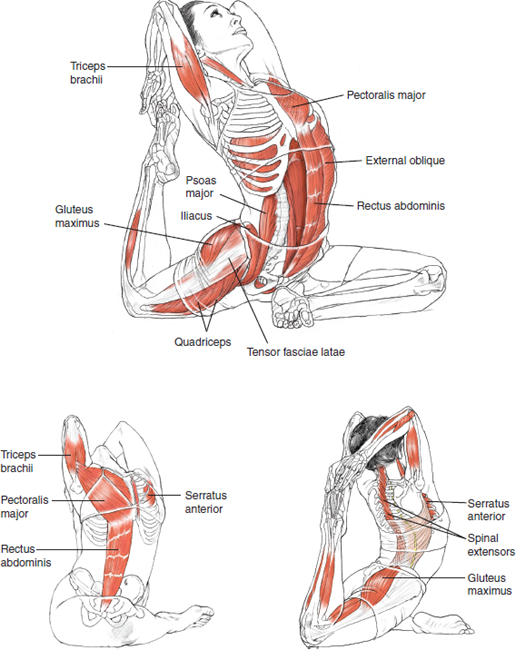
The spine undergoes extension, with the hips extending and internally rotating. The knees extend, and the scapulae rotate downward, adduct, and elevate. The arms externally rotate, extend, and adduct, while the elbows extend.
Working
Gravity pulls the torso into the backbend, which is resisted by the arms and the eccentric action of the spinal flexors.
In the arms, the triceps extend the glenohumeral and elbow joints, while the trapezius and rhomboids adduct the scapulae. The posterior deltoids and teres major also extend the glenohumeral joint, with the subscapularis protecting it anteriorly.
In the cervical spine, the anterior neck muscles (longus capitis, longus colli, rectus capitis anterior, suprahyoid, and infrahyoid) work eccentrically to prevent the head from collapsing. The rectus abdominis, external obliques, intercostals, subcostals, iliacus, and psoas major and minor work eccentrically to prevent collapsing into the lumbar spine.
In the legs, the rectus femoris works eccentrically against the weight of the pelvis moving backward, and the vastii concentrically press the shins into the floor. The hamstrings and adductor magnus work concentrically to stabilize the knees and hips.
Lengthening
In the arms, the pectoralis major and minor, coracobrachialis, biceps, and anterior deltoids stretch.
In the cervical spine, the anterior neck muscles work at length, and the sternocleidomastoid should lengthen to avoid pulling the base of the skull into the atlas and axis. The scalenes provide support for the anterior spine.
In the thoracic region, the internal intercostals stretch due to the rib cage opening, and the scalenes also lengthen as part of the intercostal muscle layers.
Joint Actions
The spine undergoes extension. The front leg experiences nutation, hip flexion, external rotation, and abduction, with knee flexion and ankle/foot supination. The back leg involves counternutation, hip extension, internal rotation, and adduction, with knee flexion and ankle plantarflexion.
Working
The spinal extensors create the backbend, while the extensors and obliques maintain balance and orientation to the front. The back leg’s internal rotation and extension make the joint capsule taut, similar to Natarajasana. In the front leg, gravity is the main force, and the hamstrings, gluteus maximus, and peroneals work eccentrically to resist collapsing into the pose.
Lengthening
When the front leg is abducted, the rotators (obturator externus and quadratus femoris) are slightly lengthened, but the hamstrings stretch more despite knee flexion. When the front leg is adducted, flexion and adduction of the hip lengthen the piriformis, obturator internus, and gemelli, with the obturator externus and quadratus femoris lengthening slightly less.
As the front leg’s knee extends toward 90 degrees, hip rotation intensifies, and stretching may be felt in the gluteus medius, minimus, adductor magnus, or longus. This action increases pressure on the knee, especially if there is hip joint restriction, and makes the knee more vulnerable to twisting forces at 90 degrees. The feet and ankles help stabilize and protect the knee.
Joint Actions
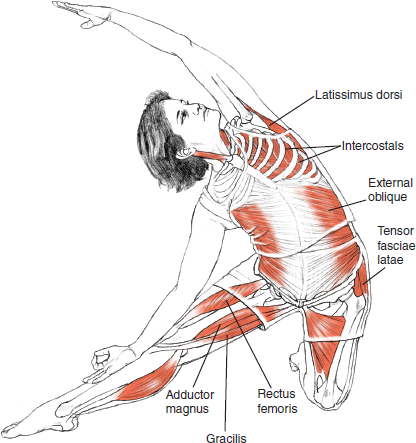
The spine laterally flexes with some rotation to maintain neutral alignment, and the cervical spine rotates and extends. The sacroiliac joint remains neutral. The standing leg involves hip neutral extension, adduction, internal rotation, knee flexion, and ankle dorsiflexion to press into the floor for balance. The extended leg experiences hip flexion, external rotation, abduction, knee extension, and ankle plantarflexion. The top arm performs scapular upward rotation, elevation, with glenohumeral external rotation, elevation, and flexion, while the elbow extends and the forearm supinates. The bottom arm remains neutral at the scapula with glenohumeral external rotation and forearm supination.
Working
The spine lengthens eccentrically in the external obliques, resisting gravity's pull. The internal obliques on the upper side and external obliques on the lower side work concentrically to prevent twisting of the body.
In the extended leg, muscles like the sartorius, piriformis, gemelli, and obturator internus engage to rotate and abduct the leg, while the hamstrings and piriformis prevent the collapse of the hip joint and knee hyperextension. The soleus and intrinsic foot muscles point the toes downward.
In the kneeling leg, the gluteus medius and minimus work eccentrically to prevent excessive lateral hip shifting. The adductor magnus maintains internal rotation and extension of the hip, and the quadriceps extend the knee to press the lower leg into the floor, assisted by the ankle dorsiflexors.
In the top arm, the serratus anterior assists with scapular abduction and upward rotation, while the infraspinatus and teres minor externally rotate the glenohumeral joint, and the deltoids elevate the arm. The bottom arm remains mostly at rest.
Lengthening
The top side experiences lengthening in the rhomboids, latissimus dorsi, long head of the triceps, intercostals, quadratus lumborum, external and internal obliques, gluteus medius and minimus, tensor fascia latae, gluteus maximus, rectus femoris, iliacus, and psoas on the standing leg.
In the extended leg, the hamstrings, gracilis, and adductor magnus lengthen.
Joint Actions
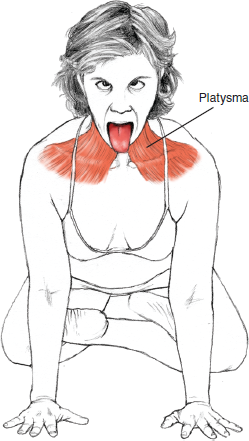
The atlanto-occipital joint flexes, while the spine remains in neutral extension. The eyeballs adduct and elevate.
Working
The tongue activates to lift the hyoid bone, engaging the digestive system and activating the hyoid muscles, sternum, rectus abdominis, pubic bone, and pelvic floor. A strong exhalation (lion’s roar) activates the three diaphragms: thoracic, pelvic, and vocal. The platysma muscle can also contract during the pose. The superior and medial rectus muscles of the eyes contract to direct the gaze inward and upward.
Lengthening
The jaw muscles, including the temporalis, masseter, lateral and medial pterygoids, and the tongue, stretch.