Yoga Anatomy
Arm Balancing Poses
Joint Actions
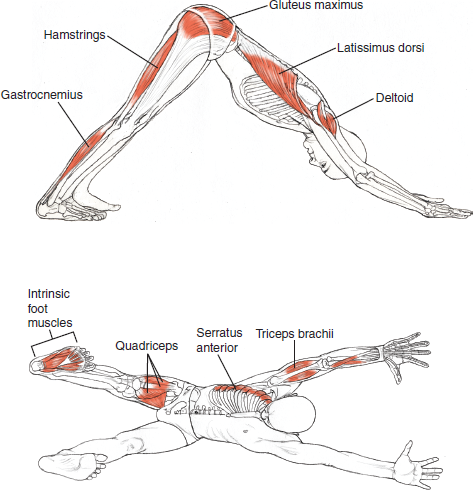
Spine: Neutral or axial extension Scapulae: Upward rotation, elevation; initially abducted but moving toward adduction in advanced practice Shoulders: Flexion and external rotation at the glenohumeral joint Elbows: Extension Forearms & Wrists: Pronation and wrist extension Pelvis & Hips: Sacrum in nutation, hip flexion (potentially some internal rotation) Legs: Knee extension, ankle dorsiflexion
Working
Spine:
The psoas minor and obliques assist in maintaining axial extension.
Deep spinal extensors work precisely to keep a neutral alignment.
Legs:
Hamstrings, gastrocnemius, and soleus lengthen to support the posture.
If hamstrings are tight, hip flexors (iliacus, rectus femoris, pectineus) may activate, though this is undesirable.
Adductor magnus helps internally rotate and stabilize the femur.
Vastii muscles and articularis genus extend the knees.
Intrinsic foot muscles help maintain the arches, while extrinsic foot muscles release at the ankle.
Arms & Shoulders:
Serratus anterior upwardly rotates and abducts the scapulae.
Infraspinatus, teres minor, and posterior deltoids externally rotate the glenohumeral joints.
Triceps extend the elbows and prevent shoulder collapse.
Latissimus dorsi can overactivate, leading to shoulder depression and internal rotation (potentially causing impingement).
Pronator muscles in the forearm engage to stabilize the hand, preventing excessive wrist or elbow strain.
Flexor carpi radialis and ulnaris help maintain the hand’s arch, preventing collapse.
Lengthening
Spine:
Diaphragm and intercostals release to allow deeper breath.
Legs:
Hamstrings, gastrocnemius, soleus, and gluteus maximus lengthen.
Psoas major, iliacus, rectus femoris, tibialis anterior, tensor fascia latae, and pectineus release for greater ease in hip flexion and spinal extension.
Arms & Shoulders:
Latissimus dorsi and teres major lengthen.
Long head of triceps works eccentrically to stabilize the pose.
Joint Actions
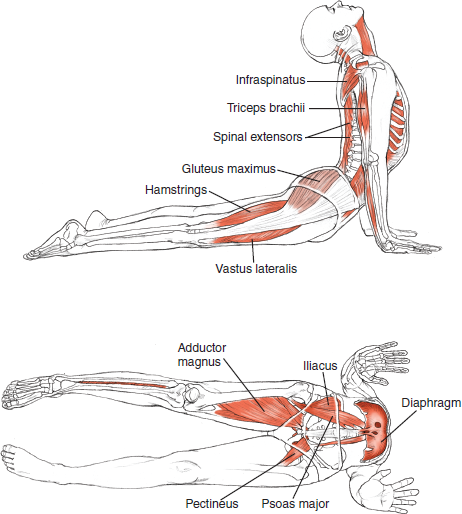
Spine: Full spinal extension
Sacrum: Counternutation
Hips: Extension, internal rotation, adduction
Knees: Extension
Ankles & Toes: Plantarflexion, toe extension
Scapulae: Adduction, upward rotation
Shoulders: Extension, neutral rotation (some may need slight internal or external rotation for alignment)
Elbows: Extension
Forearms & Wrists: Pronation, wrist extension, finger extension
Working
Spine:
Thoracic spine: Spinal extensors (semispinalis thoracis, spinalis thoracis, interspinalis, rotatores) deepen extension.
Lumbar spine: Gravity assists with extension, so psoas minor and obliques eccentrically engage to prevent excessive lordosis.
Cervical spine: Gravity extends the neck, requiring anterior neck muscles to work eccentrically for balance.
Legs:
Hamstrings and gluteus maximus (extensor portion) extend the hips.
Adductor magnus and gracilis contribute to internal rotation, extension, and adduction.
Vastii muscles and articularis genus extend the knees.
Arms & Shoulders:
Serratus anterior, rhomboids, and trapezius work together to upwardly rotate and adduct the scapulae.
Rotator cuff muscles (supraspinatus, infraspinatus, subscapularis, teres minor) stabilize the humerus in neutral alignment.
Posterior deltoids and triceps extend the shoulders and elbows.
Forearm pronators and intrinsic hand muscles distribute pressure to reduce wrist strain.
Lengthening
Spine & Neck:
Rectus abdominis, obliques, psoas major (lengthening due to spinal extension).
Sternocleidomastoid, suprahyoid, infrahyoid (lengthening due to cervical extension).
Legs:
Rectus femoris, iliacus, psoas major (lengthening due to hip extension).
Arms & Rib Cage:
Biceps, pectoralis major and minor, coracobrachialis, anterior deltoids, subclavius (lengthening due to shoulder extension).
Internal intercostals, transversus thoracis, serratus posterior inferior (lengthening due to rib cage expansion).
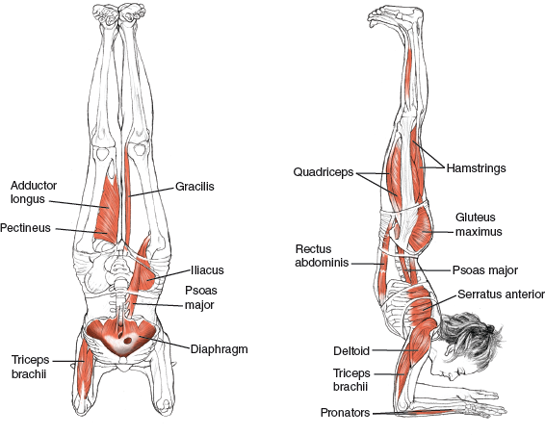
Joint Actions
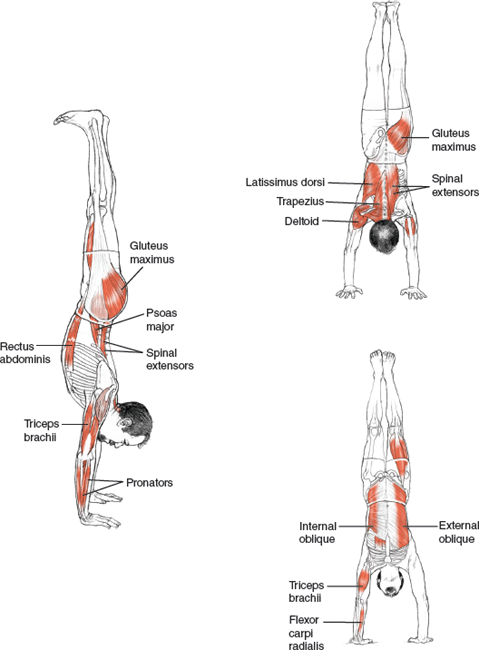
Spine: Cervical extension, slight thoracic and lumbar extension
Sacrum: Neutral sacroiliac joints
Hips: Neutral extension, adduction, slight internal rotation
Knees: Extension
Ankles: Neutral dorsiflexion (as opposed to a gymnastic handstand, which uses plantarflexion)
Scapulae: Upward rotation and abduction
Shoulders: Flexion and external rotation
Elbows: Extension
Forearms & Wrists: Pronation, wrist dorsiflexion
Working
Legs & Core:
Hamstrings work to resist gravity’s pull into hip flexion.
Adductor magnus maintains adduction, internal rotation, and extension.
Iliacus and psoas major stabilize the lumbar spine, preventing hyperextension.
Transversus abdominis and obliques engage strongly to stabilize the spine.
Spinal extensors help lift into the pose and maintain balance.
Gluteus maximus assists in lifting the legs but does not need to remain overly active.
Arms & Shoulders:
Serratus anterior creates upward rotation and stabilization of the scapulae.
Deltoids flex the shoulders.
Infraspinatus, teres minor, and posterior deltoids maintain external rotation in the glenohumeral joint.
Triceps maintain elbow extension.
Forearm pronators counterbalance humeral rotation.
Flexor carpi radialis and ulnaris stabilize the wrists and protect the carpal tunnel.
Intrinsic hand muscles engage to maintain the arches of the hands, preventing wrist collapse.
Lengthening
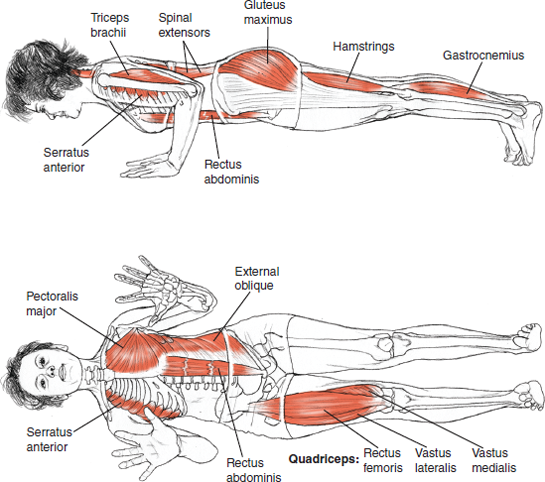
Joint Actions
Spine: Neutral
Sacrum: Neutral sacroiliac joint
Hips: Adduction, internal rotation, neutral extension
Knees: Flexion
Ankles: Dorsiflexion
Scapulae: Neutral (preventing winging)
Shoulders: Neutral glenohumeral joint
Elbows: Flexion
Forearms & Wrists: Pronation, wrist extension
Working
Core & Spine Stabilization:
Obliques, rectus abdominis, and psoas minor engage eccentrically to maintain a neutral spine.
Spinal extensors, particularly in the cervical spine, engage concentrically to resist head collapse.
Legs & Lower Body:
Hamstrings and adductor magnus work concentrically to stabilize the legs.
Gluteus maximus activates slightly to assist in hip extension.
Psoas major, iliacus, and rectus femoris work eccentrically to prevent hip sagging.
Vastii and articularis genus work to extend the knees.
Gastrocnemius and soleus modulate tibialis anterior to control dorsiflexion.
Intrinsic and extrinsic foot muscles help stabilize the feet.
Arms & Shoulders:
Serratus anterior works eccentrically to prevent scapular winging.
Rotator cuff muscles (subscapularis, infraspinatus, teres minor) stabilize the glenohumeral joint and counteract excessive internal rotation.
Pectoralis major, pectoralis minor, coracobrachialis, and triceps work eccentrically to control the lowering movement.
Forearm pronators and intrinsic/extrinsic hand muscles support wrist extension and stability.
Lengthening
Plantar fascia.
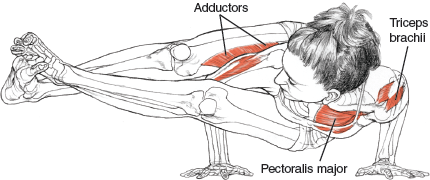
Joint Actions
Spine: Cervical extension and rotation; thoracic, lumbar, and sacral flexion and rotation
Sacrum: Nutation (forward tilting of the sacrum)
Scapulae: Downward rotation and abduction
Shoulders: External rotation and adduction
Elbows: Flexion
Forearms & Wrists: Pronation; wrist dorsiflexion
Hips: Flexion, adduction, external rotation (to enter), then internal rotation (to bind)
Knees: Flexion moving toward extension
Ankles & Feet: Dorsiflexion; foot eversion
Working
Core & Spine Stabilization:
Psoas minor, abdominal muscles, and pelvic floor create spinal flexion.
Top-leg external obliques, rotatores, and multifidi generate rotation.
Bottom-leg internal obliques and erector spinae help maintain spinal stability.
Top-side quadratus lumborum prevents hip collapse.
Sternocleidomastoid and splenius capitis assist in head rotation.
Legs & Lower Body:
Psoas major and iliacus activate for hip flexion.
Pectineus, adductor longus, and adductor brevis work for hip adduction and flexion.
Adductor magnus helps with hip adduction and internal rotation to seal the bind.
Rectus femoris contributes to hip flexion and knee extension.
Vastii muscles aid in knee extension.
Tibialis anterior supports ankle dorsiflexion.
Peroneal muscles assist with foot dorsiflexion and eversion.
Arms & Shoulders:
Infraspinatus and teres minor externally rotate the humerus.
Subscapularis, supraspinatus, long head of biceps, and anterior deltoid work eccentrically to protect the shoulder joint.
Coracobrachialis, pectoralis major, and pectoralis minor contribute to scapular abduction and downward rotation.
Serratus anterior stabilizes and abducts the scapulae.
Triceps work against gravity to keep elbows flexed.
Flexor carpi radialis and ulnaris stabilize wrists.
Intrinsic hand muscles maintain grip and control.
Lengthening
Bottom-leg external obliques and erector spinae lengthen.
Top-leg internal obliques, rotatores, and multifidi stretch.
Hamstrings lengthen due to hip flexion and knee extension.
Gluteus maximus, medius, and minimus lengthen with hip flexion and adduction.
Gastrocnemius and soleus stretch due to ankle dorsiflexion.
Rhomboids and trapezius lengthen.
Long head of biceps, anterior deltoid, subscapularis, and supraspinatus work eccentrically to maintain control.
Pectoralis minor and coracobrachialis lengthen depending on scapular positioning.
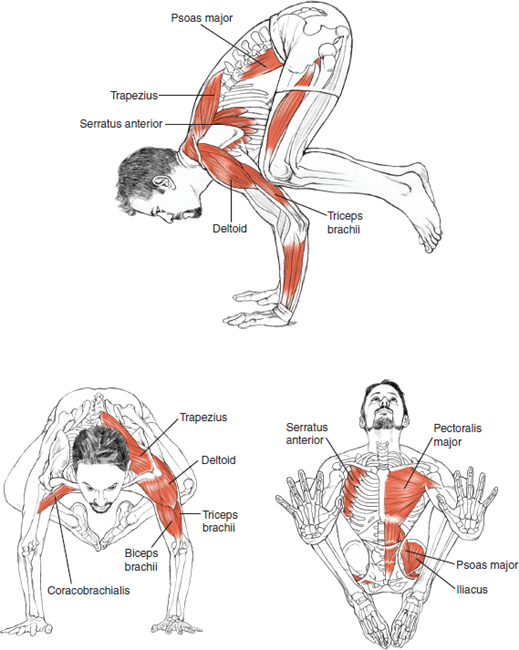
Joint Actions
Spine: Cervical extension; thoracic and lumbar flexion
Sacrum: Nutation (forward tilt)
Hips: Flexion, external rotation, adduction
Knees: Flexion
Scapulae: Downward rotation, abduction
Shoulders: External rotation, flexion, adduction
Elbows: Flexion moving toward extension
Forearms & Wrists: Pronation; wrist dorsiflexion
Working
Core & Spine Stabilization:
Psoas major & minor, abdominal muscles, and pelvic floor maintain spinal flexion.
Deep intrinsic neck muscles find cervical extension while maintaining thoracic flexion—a challenge because cervical extension often flattens the thoracic curve.
Legs & Lower Body:
Psoas and iliacus engage to flex the hip joints.
Pectineus, adductor longus, and adductor brevis assist with hip flexion and adduction.
Gracilis helps with hip adduction and knee flexion.
Hamstrings are active to maintain knee flexion.
Arms & Shoulders:
Infraspinatus and teres minor externally rotate the humerus.
Subscapularis and supraspinatus stabilize the shoulder joints.
Anterior deltoids, coracobrachialis, and pectoralis major & minor abduct and downwardly rotate the scapulae.
Serratus anterior helps abduct the scapulae.
Triceps work against gravity to help extend the elbows.
Flexor carpi radialis & ulnaris, and intrinsic hand muscles stabilize the hand’s arches for balance and grip.
The arms start in flexion but move toward extension against gravity as the body lifts into the pose.
Lengthening
Spinal extensors lengthen due to thoracic flexion.
Anterior neck muscles lengthen due to cervical extension.
Rhomboids and trapezius lengthen due to scapular abduction and downward rotation.
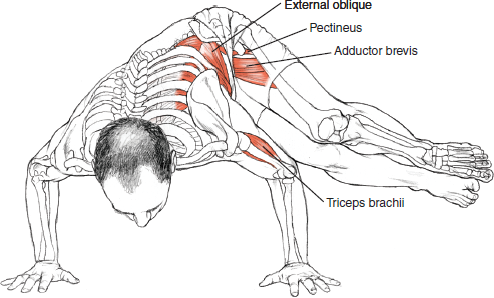
Joint Actions
Spine: Cervical extension; thoracic, lumbar, and sacral flexion and rotation
Sacrum: Nutation (forward tilt)
Hips: Flexion, internal rotation, adduction
Knees: Flexion (or extension in some variations)
Scapulae: Downward rotation, abduction
Shoulders: External rotation, flexion, abduction
Elbows: Flexion moving toward extension
Forearms & Wrists: Pronation; wrist dorsiflexion
Working
Core & Spinal Flexion with Rotation:
Same core engagement as Bakasana, but with additional rotational muscles:
Right internal obliques and left external obliques rotate the torso to the left.
Right erector spinae, left rotatores, and left multifidi assist with thoracic rotation.
Legs & Lower Body:
Same as Bakasana:
Psoas and iliacus engage to flex the hips.
Adductors (pectineus, adductor longus, brevis, and gracilis) maintain hip adduction.
Hamstrings work to keep knees flexed.
Arms & Shoulders:
Same as Bakasana, with key differences:
Arms are abducted instead of adducted, which creates a wider base of support.
Glenohumeral external rotation is crucial because the pose is more asymmetrical and places different demands on the shoulders.
Serratus anterior, deltoids, rotator cuff muscles, and triceps work to stabilize the arms and support the torso.
Lengthening
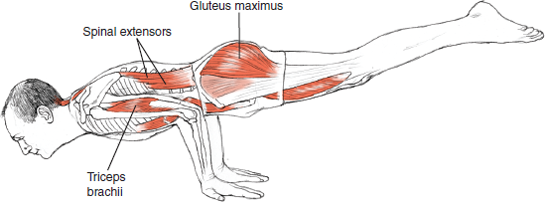
Joint Actions
Spine: Cervical extension; mild thoracic flexion; mild lumbar extension
Hips: Extension, adduction, internal rotation
Knees: Extension
Ankles: Plantarflexion
Scapulae: Downward rotation and abduction
Shoulders: External rotation, flexion, adduction
Elbows: Flexion
Forearms & Wrists: Supination; wrist dorsiflexion
Working
Spine & Core Stability:
Psoas major and minor, abdominal muscles, and pelvic floor resist the pressure of the elbows into the abdominal cavity.
Deep cervical muscles work to extend the neck while keeping thoracic flexion.
Spinal extensors (especially in the lumbar region) lift the legs off the ground.
Legs & Lower Body:
Hamstrings assist in hip extension.
Adductor magnus contributes to hip extension, internal rotation, and adduction.
Gluteus medius, minimus, and maximus support hip extension and alignment.
Arms & Shoulder Stability:
Infraspinatus and teres minor externally rotate the humerus.
Subscapularis and supraspinatus protect the front of the shoulder joint.
Anterior deltoids, coracobrachialis, pectoralis major, and pectoralis minor contribute to scapular abduction and downward rotation.
Serratus anterior stabilizes the scapulae.
Triceps work against gravity to maintain elbow extension.
Extensor carpi radialis, ulnaris, and intrinsic hand muscles engage to maintain wrist dorsiflexion and stabilize the hands.
Lengthening
Anterior neck muscles (due to cervical extension).
Rhomboids and trapezius (due to scapular abduction).
Joint Actions
Spine: Full extension (thoracic extension reduces the need for cervical and lumbar extension).
Hips: Neutral extension.
Knees: Extension.
Ankles: Neutral dorsiflexion.
Scapulae: Abduction, upward rotation, elevation.
Shoulders: Flexion, external rotation, adduction.
Elbows: Flexion.
Forearms & Wrists: Pronation (forearms), wrist dorsiflexion (flat on the floor).
Working
Spine & Core Stability:
Intrinsic spinal muscles (intertransversarii, interspinalis, rotatores, multifidi) maintain spinal extension.
Major spinal extensors (spinalis, semispinalis, longissimus dorsi, iliocostalis) engage to keep the back straight.
Psoas minor, obliques, rectus abdominis, and transversus abdominis are active eccentrically to prevent overarching and falling backward.
Legs & Lower Body:
Adductor magnus and hamstrings stabilize the legs together and maintain hip extension.
Vastii (quadriceps group) extend the knees.
Arms & Shoulder Stability:
Serratus anterior stabilizes the scapulae in abduction and upward rotation.
Infraspinatus and teres minor externally rotate the arms.
Subscapularis, supraspinatus, infraspinatus, and teres minor work together to stabilize the humeral head in the shoulder joint.
Anterior deltoids, pectoralis major, and coracobrachialis contribute to shoulder flexion and adduction.
Triceps (eccentrically) resist elbow flexion, preventing a collapse forward.
Forearm pronators engage to keep the wrists flat on the floor.
Lengthening
Latissimus dorsi (stretches as the arms are flexed overhead).
Iliacus and rectus femoris (due to neutral hip extension).
Forearm supinators (as the forearms are pronated).
Abdominal muscles and internal intercostals (as thoracic extension and rib cage expansion occur).
Anterior neck muscles (as the head stays neutral or slightly extended).
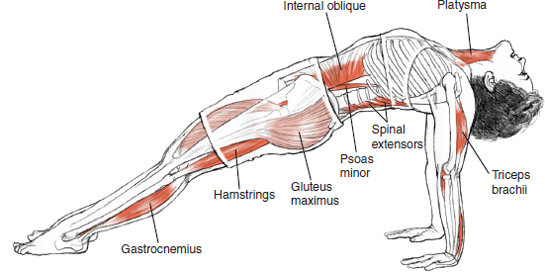
Joint Actions
Spine: Full extension.
Sacroiliac Joint: Counternutation.
Hips: Extension, internal rotation, adduction.
Knees: Extension.
Ankles: Plantarflexion.
Toes: Extension.
Scapulae: Adduction, downward rotation, elevation.
Shoulders: Extension, neutral rotation (some may need slight internal or external rotation for alignment).
Elbows: Extension.
Forearms: Pronation.
Wrists & Fingers: Wrist extension, finger extension.
Working
Spine & Core Stability:
Spinal extensors (semispinalis thoracis, spinalis thoracis, interspinalis, rotatores) are most active in the thoracic region to counteract gravity.
Psoas minor and obliques eccentrically control excessive lumbar lordosis.
Anterior neck muscles (longus capitis, longus colli, sternocleidomastoid, suprahyoid, and infrahyoid muscles) engage eccentrically to prevent excessive cervical extension.
Legs & Lower Body:
Hamstrings (primary hip extenders), assisted by the gluteus maximus (extensor portion), extend the hips.
Adductor magnus contributes to hip extension, internal rotation, and adduction.
Gracilis assists in hip adduction.
Quadriceps (vastii and articularis genus) extend the knees.
Gastrocnemius and soleus create ankle plantarflexion.
Intrinsic and extrinsic foot muscles extend the toes.
Arms & Shoulder Stability:
Teres major, posterior deltoids, and triceps extend the humerus.
Rhomboids and trapezius maintain scapular adduction.
Rotator cuff muscles (supraspinatus, infraspinatus, subscapularis, teres minor) stabilize the shoulder joint in neutral alignment.
Triceps extend the elbows.
Forearm pronators and intrinsic hand muscles distribute weight evenly through the hands, protecting the heel of the hand from excessive pressure.
Lengthening
Spine: Rectus abdominis, obliques, psoas major, sternocleidomastoid, suprahyoid, infrahyoid.
Legs: Rectus femoris, iliacus, psoas major.
Arms: Serratus anterior, biceps, pectoralis major and minor, coracobrachialis, anterior deltoid, subclavius.
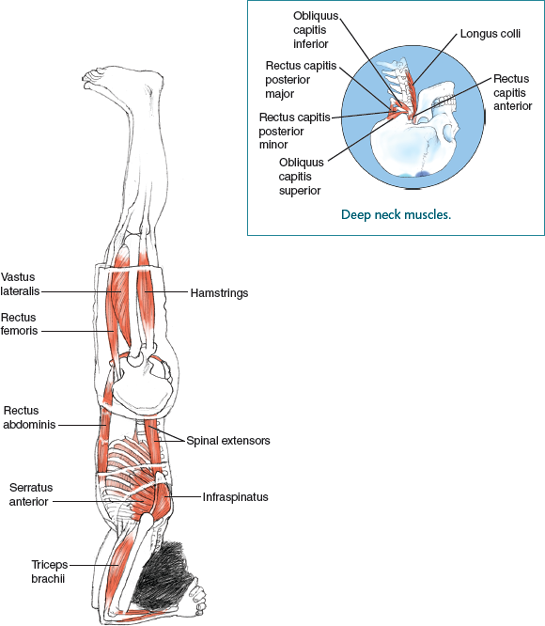
Joint Actions
Spine: Neutral axial extension (or slight extension).
Hips: Extension.
Knees: Extension.
Ankles: Neutral dorsiflexion.
Scapulae: Abduction, upward rotation, elevation.
Shoulders: Flexion, external rotation, adduction.
Elbows: Flexion.
Forearms: Neutral rotation.
Weight Placement
The bregma (junction of the coronal and sagittal sutures) allows for a slightly arched final position.
Placing the weight closer to the crown of the head leads to a more neutral spinal alignment, with balanced engagement between the anterior and posterior chains of the body.
Working
Spine & Core Stability:
Intrinsic spinal muscles (intertransversarii, interspinalis, rotatores, multifidi, spinalis, semispinalis, splenius capitis and cervicis, longissimus, iliocostalis) stabilize and prevent forward collapse.
Thoracic spine extensors lift the lower body weight into inversion.
Psoas minor, obliques, rectus abdominis, and transversus abdominis eccentrically engage to prevent backward tipping.
Pelvic diaphragm and lower abdominals engage, reinforcing mula bandha.
Neck Stability:
Deep cervical muscles (rectus capitis anterior, rectus capitis posterior major and minor, obliquus capitis superior and inferior, longus capitis, longus colli) balance the atlanto-occipital and atlanto-axial joints, preventing excessive cervical compression.
Shoulder & Arm Stability:
Serratus anterior stabilizes the scapulae against winging.
Rotator cuff (infraspinatus, teres minor, supraspinatus, subscapularis) externally rotates and stabilizes the humerus.
Triceps brachii stabilizes the elbows.
Flexor and extensor carpi ulnaris press the little finger side of the hands into the floor for a stable base.
Legs & Lower Body Engagement:
Adductor magnus and hamstrings keep the legs together and extend the hips.
Quadriceps (vastii muscles) extend the knees.
Gluteus maximus (medial fibers) extends the hips without external rotation.
Lengthening
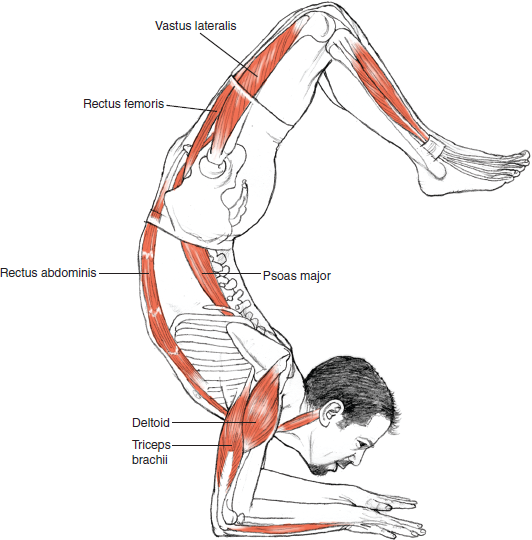
Joint Actions
Spine: Full extension.
Hips: Extension, adduction, internal rotation.
Knees: Flexion.
Ankles: Neutral dorsiflexion.
Scapulae: Adduction, upward rotation.
Shoulders (Glenohumeral Joint): External rotation, flexion, adduction.
Elbows: Flexion.
Forearms: Pronation.
Working
Core & Spine Stability:
Spinal extensors (spinalis, semispinalis, longissimus, iliocostalis, multifidi, rotatores) deepen the backbend and lift the head against gravity.
Serratus anterior works eccentrically to control the scapulae adduction.
Obliques, rectus abdominis, and transversus abdominis engage to stabilize the spine and prevent excessive collapse into the lower back.
Shoulder & Arm Stability:
Serratus anterior stabilizes the scapulae and prevents winging.
Rotator cuff (infraspinatus, teres minor, supraspinatus, subscapularis) stabilizes and externally rotates the humerus.
Triceps brachii stabilizes the elbows.
Pronator teres and pronator quadratus help forearm pronation to distribute weight evenly through the arms.
Legs & Hip Mechanics:
Hamstrings actively flex the knees and draw the toes toward the head (if flexibility allows).
Adductor magnus keeps the legs adducted and assists in hip extension and internal rotation.
Gluteus maximus (medial fibers) extends the hips without excessive external rotation.
Lengthening
Latissimus dorsi (due to shoulder flexion and spinal extension).
Rectus femoris and iliacus (due to hip extension and knee flexion).
Vastii muscles (due to deep knee flexion).
Pectoralis major and minor (due to thoracic extension and scapula adduction).
Anterior neck muscles (as the head moves toward the feet).
Internal intercostals and abdominal muscles (as the front body opens).
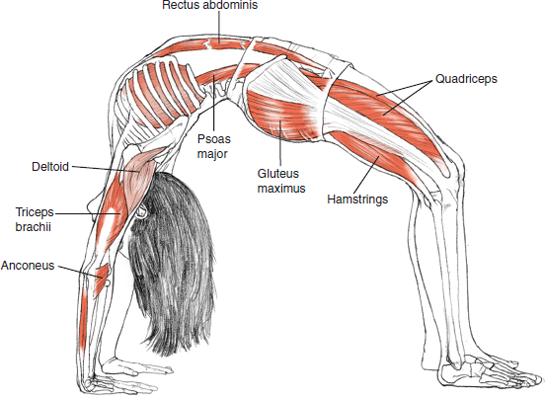
Joint Actions
Spine: Full extension.
Sacroiliac Joint: Counternutation.
Hips: Extension, internal rotation, adduction.
Knees: Extension.
Ankles: Dorsiflexion.
Scapulae: Upward rotation, abduction (deepens into adduction with greater thoracic extension).
Shoulders (Glenohumeral Joint): Flexion, external rotation, adduction.
Elbows: Extension.
Forearms: Pronation.
Wrists: Dorsiflexion.
Working
Spine & Core Stability:
All spinal extensors engage, especially the deep stabilizers (interspinalis, intertransversarii, rotatores, multifidi, and transversospinalis group).
Psoas minor and abdominal muscles work eccentrically to control excessive lumbar extension and encourage more thoracic extension.
Legs & Hip Mechanics:
Hamstrings & Adductor magnus extend the hips.
Gluteus maximus assists in hip extension, but excessive activation can externally rotate the legs (which should be avoided).
Vastii muscles (vastus lateralis, medialis, intermedius) extend the knees.
Arms & Shoulder Stability:
Infraspinatus, teres minor, and posterior deltoid externally rotate the shoulders.
Subscapularis stabilizes the anterior shoulder joint.
Serratus anterior abducts the scapulae and helps elevate the arms.
Deltoids flex the shoulders.
Triceps and anconeus extend the elbows.
Coracobrachialis flexes and adducts the arms at the shoulders.
Forearm pronators (pronator teres, pronator quadratus) help turn the palms downward.
Lengthening
Legs:
Rectus femoris, psoas major, iliacus (due to hip extension).
Torso:
Abdominal muscles and anterior rib cage muscles (internal intercostals and anterior neck muscles) lengthen due to spinal extension and rib expansion.
Arms & Shoulders:
Pectoralis major & minor, latissimus dorsi lengthen due to shoulder flexion and external rotation.
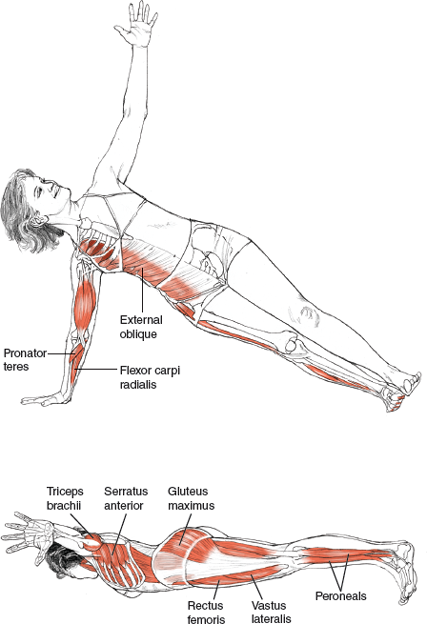
Joint Actions
Spine: Neutral.
Hips: Neutral extension, adduction, internal rotation.
Knees: Extension.
Ankles & Feet: Dorsiflexion and eversion (bottom foot resisting gravity).
Scapulae: Neutral, abducting against gravity.
Shoulders (Glenohumeral Joint): Lateral abduction, external rotation.
Elbows: Extension.
Wrists & Forearms:
Bottom hand: Pronation, wrist dorsiflexion.
Top hand: Neutral forearm, neutral wrist extension.
Working
Spine & Core Stability:
Spinal extensors maintain neutral spinal alignment.
Rectus abdominis, transversus abdominis, and obliques stabilize the torso.
Quadratus lumborum resists the hips dropping.
Sternocleidomastoid (bottom side) & splenius capitis (top side) support head rotation upward.
Torso Mechanics:
Top side: External obliques concentrically resist the hips twisting forward; internal obliques eccentrically resist the hips falling backward.
Bottom side: Internal obliques concentrically pull the hip forward; external obliques eccentrically resist hip collapse.
Legs & Hip Stability:
Adductor magnus (top & bottom leg) internally rotates & extends the hips.
Hamstrings extend the hips.
Vastii muscles extend the knees.
Tibialis anterior & extensor digitorum dorsiflex the ankle and extend the toes.
Peroneal muscles evert the bottom foot against gravity.
Gluteus medius & minimus hold the hips off the floor (bottom leg).
Arms & Shoulder Stability:
Top Arm:
Infraspinatus & teres minor externally rotate the shoulder.
Serratus anterior, trapezius, and deltoid lift the arm.
Triceps extend the elbow.
Extensor carpi & extensor digitorum extend the wrist & fingers.
Bottom Arm:
Serratus anterior stabilizes the scapula against adduction.
Infraspinatus & teres minor externally rotate the shoulder.
Subscapularis & supraspinatus stabilize the humeral head.
Deltoid stabilizes the humerus.
Triceps extend the elbow.
Forearm pronators, flexor carpi ulnaris & radialis, and intrinsic hand muscles support the wrist & palm.
Lengthening
Latissimus dorsi (due to arm elevation).
Pectoralis major & minor (due to shoulder abduction & external rotation).
Coracobrachialis (due to arm extension & abduction).
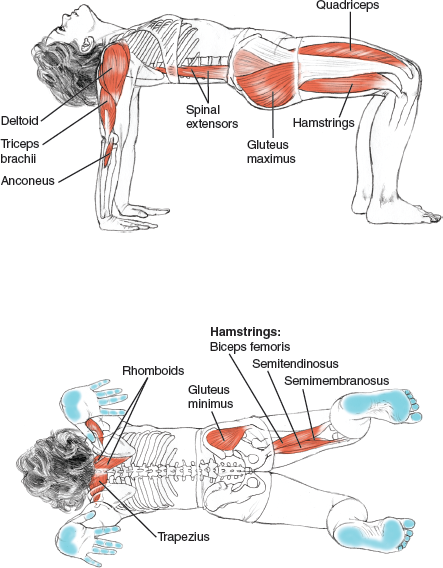
Joint Actions
Spine: Slight lumbar & thoracic extension; cervical extension.
Hips: Neutral extension, adduction, internal rotation.
Knees: Flexion.
Ankles: Dorsiflexion.
Scapulae: Downward rotation, adduction, elevation.
Shoulders (Glenohumeral Joint): Extension, external rotation.
Elbows: Extension.
Forearms & Wrists:Forearm pronation, Wrist dorsiflexion.
Working
Legs & Hip Stability:
Hamstrings & adductor magnus counteract gravity by maintaining hip extension, adduction, and internal rotation.
Gluteus maximus assists with hip extension, but must be controlled to prevent excessive external rotation.
Quadriceps (eccentrically) control knee flexion.
Tibialis anterior works to draw knees forward over the feet.
Arms & Shoulder Stability:
Rhomboids & middle trapezius work concentrically to adduct the scapulae.
Levator scapulae elevates the scapulae.
Teres major, triceps, posterior deltoids, and latissimus dorsi extend the arms and downwardly rotate the scapulae.
Triceps extend the elbows.
Forearm pronators rotate the palms downward.
Torso & Core Stability:
Obliques, rectus abdominis, and psoas minor resist lumbar hyperextension caused by gravity.
Lengthening
Legs: Quadriceps (eccentrically), iliacus, psoas major & minor.
Torso: Abdominal muscles (all layers active but lengthened), anterior neck muscles.
Arms: Pectoralis major & minor, coracobrachialis.